

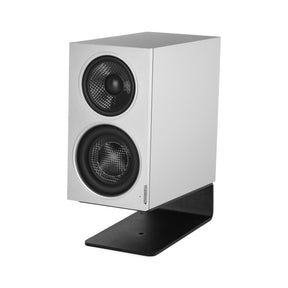

MX121
Cinema Subwoofer
Passive cinema subwoofer with a single 12-inch driver in a compact enclosure driven from a conventional amplifier channel, for LFE reproduction. Hall depth ≤ 3/4 m (1 unit), ≤ 4/6 m (2 units)1
Cinema LFE channels · Small to medium commercial auditoriums · Screening rooms · Private cinemas
Features
- A single 12″ low-frequency driver with a 65.5 mm voice coil, 28.6 mm winding and 180 mm magnet, for long-excursion low-frequency output (the same driver as the MX122).
- 95 dB sensitivity with a 300 W AES 100-hour rating (600 W program).
- 119.8 dB rated maximum SPL — continuous, on the AES 100-hour basis.
- A Φ35 mm magnet-assembly vent provides a rear-chamber thermal path.
- MDF bass-reflex enclosure, 347 mm deep, PVC laminate finish with a steel grille; 410 × 515 × 347 mm, 19 kg net.
- Recommended 140 Hz low-pass and 27 Hz high-pass (24 dB/oct).
- 8 Ω nominal; suited to compact or distributed low-frequency configurations where cabinet volume and placement flexibility matter.
Overview
The MX121 is a passive cinema subwoofer in the MX Series for the screen LFE channel, intended for small and mid-size auditoriums, screening rooms and multi-cabinet arrays. The system comprises a single 12″ low-frequency driver (65.5 mm voice coil, 28.6 mm winding, 180 mm magnet — the same driver as the MX122) in an MDF bass-reflex enclosure with a PVC laminate finish and a steel grille, with a 38 Hz–500 Hz response (±3 dB), 29 Hz usable at −10 dB and an 8 Ω nominal load.
At 95 dB sensitivity and a 300 W AES 100-hour rating it produces a 119.8 dB rated maximum SPL on a continuous basis. A 140 Hz low-pass is recommended for integration, with a 27 Hz high-pass limiting excessive excursion below the operating band. The cabinet measures 410 × 515 × 347 mm and weighs 19 kg net; its 347 mm depth suits the restricted space behind a screen.
Specifications
| Product Type | Cinema Subwoofer |
|---|---|
| System Type | Passive Subwoofer |
| Driver Configuration | 12" LF × 1 |
| Nominal Impedance | 8Ω |
| Frequency Response (±3 dB @ 2π)2 | 38 Hz–500 Hz |
| Frequency Range (-10 dB @ 2π)2 | 29 Hz–500 Hz |
| AES 100-Hour Power Rating3 | 300W |
| AES 2-Hour Power Rating | 375W |
| Program Power4 | 600W |
| Sensitivity (2π) @1W/1m | 95dB |
| Rated Maximum SPL /1m @ 2π | 119.8dB |
| Calculated Maximum SPL /1m @ 2π5 | 125.8dB |
| Recommended LPF | 140 Hz@24 dB/oct |
| Recommended HPF | 27 Hz@24 dB/oct |
| Coverage Angle (H×V) | — |
| Enclosure Type | Cinema subwoofer enclosure |
| Enclosure Material / Finish | MDF · PVC laminate / steel grille |
| Input Connectors | Binding posts |
| Mounting Options | Floor-standing |
| Dimensions W×H×D (mm) | W410 × H515 × D347 mm |
| Net Weight | 19 kg |
Frequency response

Dimensions


- 1Two length values are given: the first is the usable range on continuous power, the second on program power. Program power is a short-term maximum output and is not a level the system can sustain continuously. Target levels follow the SMPTE ST 202 / RP 200 cinema reference level: 95 dB for LFE plus 20 dB peak headroom, measured at the reference listening position (RLP); hall depth = listening distance x 1.5. Listening distance is derived from free-field distance attenuation. The continuous-power range uses the rated maximum SPL in this table; the program-power range uses the rated value +3 dB (program power being twice the continuous power). The calculated maximum SPL (rated +6 dB, short-term peak) is not used for these figures. Subwoofer arrays use non-coherent summation (+3 dB per doubling of cabinet count, +3 dB per doubling of power). Screen loss, power compression, system limiting and room gain are not included - this is a theoretical estimate, not a measured guarantee; on-site verification is recommended. Operating beyond the recommended figure may result in, but is not limited to: dynamic compression, increased distortion, extraneous noise, and in severe cases equipment damage.
- 2Low-frequency response and sensitivity specifications are referenced to half-space (2π) conditions, representative of typical cinema baffle-wall installation. Frequency-response graphs are measured in an anechoic free-field (4π) environment unless otherwise noted. In the low-frequency region the same loudspeaker measures about 6 dB higher under 2π than under 4π (in practice 3–6 dB depending on frequency and baffle conditions); this is a difference of measurement convention, not of performance.
- 3Rating based on an IEC filtered random-noise test signal, band-limited 30 Hz–500 Hz, with a peak-to-average ratio of 6 dB
- 4Recommended amplifier output at the applicable impedance should not exceed the program power, giving an unclipped output waveform while avoiding loudspeaker damage; an amplifier capable of at least the RMS continuous power (AES 100 h) is recommended to realize full loudspeaker performance. The actual amplifier match should be determined by calculation for the listening distance (see note 1).
- 5Calculated maximum SPL is derived from the rated (continuous) power and half-space (2π) sensitivity and is a calculated, not measured, figure; at a 6 dB peak-to-average ratio it exceeds the rated value by 6 dB, representing short-term peak capability rather than a level the system can sustain.
- 6The frequency-response graphs on this page are measured on-axis at 1 W/1 m in an anechoic free-field (4π) environment with 1/6-octave smoothing; the frequency response and sensitivity in the specification table are stated under half-space (2π) conditions. Lower readings in the low-frequency region of the graph therefore reflect the difference in convention rather than a difference in performance. 2π-format curves are available on request.
More subwoofer systems
All 7 models


