

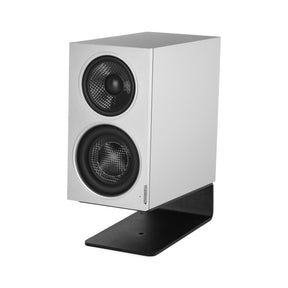

ES3110
Cinema Screen Loudspeaker System
Compact three-way, bi-amplified screen-channel system for non-acoustically-transparent Direct-View LED walls, mounted around the LED wall. Hall depth ≤ 10 m/15 m1
Main channels for LED direct-view screens · LED-screen cinemas · Private cinemas
Features
- Three-way bi-amplified system formed by a dual-15-inch low-frequency module and a 10-inch midrange / 3-inch high-frequency module in two cabinets.
- 3-inch compression driver with SOVOX HLMS™ dual shorting rings (copper sleeve and aluminium ring), a motor-level design for controlling magnetic modulation at high drive levels.
- 15-inch LF and 10-inch MF drivers use SOVOX ADM™ coated, cloth-edged paper cones; frequency response 38 Hz–20 kHz (±3 dB, 2π) with usable extension to 28 Hz.
- Active Linkwitz–Riley 24 dB/oct crossover at 300 Hz separates the LF and mid/high amplifier channels, with a built-in 2.0 kHz passive network within the mid/high module.
- The mid/high module is 324 mm wide and 302 mm deep and mounts close to the LED screen structure, while the LF module stands on the floor.
- Screen-frame mounting around the LED panel — no acoustically transparent screen required.
Overview
The ES3110 is a compact three-way, bi-amplified screen-channel system designed for cinemas using non-acoustically-transparent LED displays. It pairs a bass-reflex dual-15-inch low-frequency module with a sealed mid/high module carrying a 10-inch midrange and a 3-inch compression driver, covering 38 Hz–20 kHz (±3 dB) with 90° × 45° nominal coverage.
Bi-amplified drive keeps the low and mid/high sections focused on their own bands, while a 302 mm deep mid/high module mounts by screen frame around the LED panel with no acoustically transparent screen required — so the screen channel seats right beside the picture, with the acoustic image sourced from the screen plane.
Specifications
| Product Type | Cinema Screen Loudspeaker System | |
|---|---|---|
| System Type | 3-Way, Bi-Amplified | |
| Frequency Response (±3 dB @ 2π)2 | 38 Hz–20 kHz | |
| Frequency Range (-10 dB @ 2π)2 | 28 Hz–20 kHz | |
| Coverage Angle (H×V) | 90° × 45° | |
| M260(W)LF MODULE | ES3110(T)MF / HF MODULE | |
| Driver Configuration | 15" LF × 2 | 10"MF + 3"HF |
| Nominal Impedance | 4Ω | 6Ω |
| AES 100-Hour Power Rating3 | 800W | 280W |
| AES 2-Hour Power Rating | 1000W | 350W |
| Program Power4 | 1600W | 560W |
| Sensitivity (2π) @1W/1m | 102dB | 97dB |
| Rated Maximum SPL /1m @ 2π | 131dB | 121.5dB |
| Calculated Maximum SPL /1m @ 2π5 | 137dB | 127.5dB |
| Crossover Frequency | LR-24dB oct @300 Hz (LF–MF HF) | 2.0 kHz passive (MF–HF) |
| Recommended HPF | 25 Hz, LR24 | - |
| Enclosure Type | Bass-reflex enclosure | Sealed enclosure |
| Enclosure Material / Finish | MDF · PVC laminate | MDF · PVC laminate |
| Input Connectors | Binding posts | Binding posts |
| Mounting Options | Screen-frame mounting | LED screen-frame mounting |
| Dimensions W×H×D (mm) | W701 × H961 × D450 mm | W324 × H568 × D302 mm |
| Net Weight | 44.3 kg | 15 kg |
Frequency response


Dimensions


- 1Two length values are given: the first is the usable range on continuous power, the second on program power. Program power is a short-term maximum output and is not a level the system can sustain continuously. Target levels follow the SMPTE ST 202 / RP 200 cinema reference level: 85 dB for screen channels plus 20 dB peak headroom, measured at the reference listening position (RLP); hall depth = listening distance x 1.5. Listening distance is derived from free-field distance attenuation. The continuous-power range uses the rated maximum SPL in this table; the program-power range uses the rated value +3 dB (program power being twice the continuous power). The calculated maximum SPL (rated +6 dB, short-term peak) is not used for these figures. Screen loss, power compression, system limiting and room gain are not included - this is a theoretical estimate, not a measured guarantee; on-site verification is recommended. Operating beyond the recommended figure may result in, but is not limited to: dynamic compression, increased distortion, extraneous noise, and in severe cases equipment damage.
- 2Low-frequency response and sensitivity specifications are referenced to half-space (2π) conditions, representative of typical cinema baffle-wall installation. Frequency-response graphs are measured in an anechoic free-field (4π) environment unless otherwise noted. In the low-frequency region the same loudspeaker measures about 6 dB higher under 2π than under 4π (in practice 3–6 dB depending on frequency and baffle conditions); this is a difference of measurement convention, not of performance.
- 3Rating based on an IEC filtered random-noise test signal, band-limited 50 Hz–20 kHz, with a peak-to-average ratio of 6 dB
- 4Recommended amplifier output at the applicable impedance should not exceed the program power, giving an unclipped output waveform while avoiding loudspeaker damage; an amplifier capable of at least the RMS continuous power (AES 100 h) is recommended to realize full loudspeaker performance. The actual amplifier match should be determined by calculation for the listening distance (see note 1).
- 5Calculated maximum SPL is derived from the rated (continuous) power and half-space (2π) sensitivity and is a calculated, not measured, figure; at a 6 dB peak-to-average ratio it exceeds the rated value by 6 dB, representing short-term peak capability rather than a level the system can sustain.
- 6The frequency-response graphs on this page are measured on-axis at 1 W/1 m in an anechoic free-field (4π) environment with 1/6-octave smoothing; the frequency response and sensitivity in the specification table are stated under half-space (2π) conditions. Lower readings in the low-frequency region of the graph therefore reflect the difference in convention rather than a difference in performance. 2π-format curves are available on request.
More screen channel systems
All 21 models


