
D series
Cinema Power Amplifier
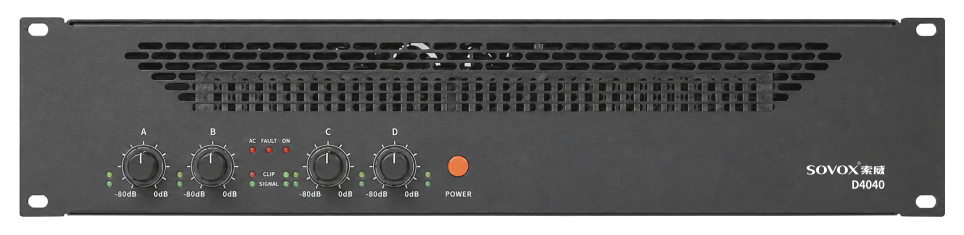
The D2040 / D2060 / D4040 / D4060 are four models on one digital amplification platform in Class D, offered in two- and four-channel configurations, powering the low-frequency and mid/high modules of active-crossover screen channels as well as surround channels and subwoofers.
Screen channels · Surround channels · Subwoofers (LFE) · Rack-based multi-channel drive
Features
- Class D digital amplification in two- and four-channel configurations — select directly by channel count and power level.
- All four share one input/output platform and protection design, stepping in channel count and output power.
- Parallel / stereo / bridged operation; four-channel models bridge into two higher-power outputs.
- Switching-mode supply; 245 / 315 mm chassis depth and 4.5 / 5.2 kg net weight.
- XLR female / male inputs and red-black binding post outputs; short-circuit, over-temperature, DC, subsonic and HF protection.
- AC 100–240 V wide-range supply for varying mains conditions; uniform 2U (88 mm) rack height.
- Switching-mode supply and Class D topology: lighter chassis and lower heat, suited to lightweight racks.
Overview
The D2040 / D2060 / D4040 / D4060 are four models on one digital amplification platform in Class D, offered in two- and four-channel configurations, powering the low-frequency and mid/high modules of active-crossover screen channels as well as surround channels and subwoofers. All four share the same input/output platform and protection design, differing in channel count and output power level.
Two-channel models suit paired drive of screen channels and subwoofers; four-channel models suit grouped drive of surround channels. The switching-mode supply and Class D topology keep the chassis light — 4.5–5.2 kg net — which helps where rack load capacity or heat dissipation is limited.
Specifications
| D2040 | D2060 | D4040 | D4060 | |
| Amplifier Class | Class D | |||
| Channels | 2 | 2 | 4 | 4 |
| Rated Output Power (8 Ω) | 400 W × 2 | 600 W × 2 | 400 W × 4 | 600 W × 4 |
| Rated Output Power (4 Ω) | 800 W × 2 | 1200 W × 2 | 800 W × 4 | 1200 W × 4 |
| Bridged Output Power (8 Ω) | 1500 W | 2000 W | 2 × 1500 W | 2 × 2000 W |
| Frequency Response | 20 Hz–20 kHz | |||
| Total Harmonic Distortion THD | < 0.005% (1 kHz @ 1 W) | |||
| Signal-to-Noise Ratio | > 115 dB (A-weighted) | > 117 dB (A-weighted) | > 115 dB (A-weighted) | > 117 dB (A-weighted) |
| Damping Factor | > 300 | |||
| Input Sensitivity / Impedance | 0.775 V / 1.4 V · 20 kΩ balanced / 10 kΩ unbalanced | |||
| Voltage Gain | 32 dB | 34 dB | 32 dB | 34 dB |
| Input Connectors | XLR female / XLR male | |||
| Output Connectors | Red-black binding posts | |||
| Operating Modes | Parallel / Stereo / Bridged | |||
| Cooling | Temperature-controlled fan × 1 | Temperature-controlled fan × 1 | Temperature-controlled fan × 2 | Temperature-controlled fan × 2 |
| Protection | Short circuit · Over-temperature · DC · Subsonic · HF | |||
| Power Supply | AC 100–240 V (wide range) | |||
| Rack Height | 2U (88 mm) | |||
| Dimensions W×H×D (mm) | W483 × H88 × D245 | W483 × H88 × D245 | W483 × H88 × D315 | W483 × H88 × D315 |
| Net Weight | 4.5 kg | 4.5 kg | 5.2 kg | 5.2 kg |
- 1Output power figures are continuous (RMS) outputs at the stated impedance. An amplifier’s continuous output should be at least the AES 100-hour rating of the loudspeaker it drives, and its output at the matching impedance should not exceed the loudspeaker’s program power, to avoid clipping and driver damage (see the relevant loudspeaker specification sheet).
- 2THD, signal-to-noise ratio and damping factor are measured under the manufacturer’s test conditions; readings taken under different conventions are not directly comparable. Figures shown without a model split are common to all models.
- 32 Ω loads are not recommended. Four-channel models bridge as two two-channel pairs; the minimum load in bridged mode is 8 Ω. Rack installation must leave the front and rear airflow paths clear, and the temperature rise inside the rack must stay within the equipment’s permitted ambient range (operating temperature 0–50 °C).
- 4⚠️ Parameters on this page are taken from the R&D-revised specification workbook. Where a later R&D revision differs, the latest revision prevails.