
By SOVOX Engineering · Published August 24, 2026 · Technical details checked August 24, 2026
The short answer
For a desk under 700 mm deep with a listening distance under a metre, a 3–4 inch woofer is usually the right size, and 5 inches is the practical upper limit.
Driver diameter buys maximum output and low-frequency extension. It does not buy accuracy, imaging or tonal balance, which come from the crossover, cabinet and driver quality — and on a desk, more than any of them, from placement.
Scope and disclosure
This guide covers woofer size selection for compact active nearfield speakers on desks. It sizes by listening distance and available depth rather than by driver diameter alone, and it explains why crossover topology changes the answer.
Disclosure: SOVOX publishes this article and manufactures a compact monitor with a 3.5″ woofer, which sits at the small end of the range discussed. The article argues that driver diameter is a poor primary criterion, which is a position that favours designs like ours — the reasoning is given so it can be assessed rather than accepted.
1. What each size gives you
3 to 3.5 inches. Extension typically into the 50–60 Hz region depending on cabinet alignment. Small excursion, easy to keep linear, and the driver stays clean into the midrange — which matters in a two-way that has to cross to a tweeter. Fits any desk.
4 to 5 inches. Extension into the 40s and noticeably more output. Needs more cabinet volume and more depth, and needs more distance to integrate, because a 5-inch two-way has its drivers further apart.
6.5 inches and up. Genuine low-end, in a cabinet designed for at least a metre and a half of listening distance and usually too deep for a desk under 700 mm. That size class is normally a bookshelf speaker; whether one belongs on a desk is its own question.
2. Size by distance, not by desk
| Listening distance | Sensible woofer size |
|---|---|
| Under 700 mm | 3–4 inch |
| 700 mm – 1 m | 3–5 inch |
| 1 – 1.5 m | 5–6.5 inch |
| Over 1.5 m | 6.5 inch and up |
At close distance you need less output to reach a given level, and driver spacing matters more. A large two-way at 600 mm presents its tweeter and woofer at a wide angle from your ear, and they do not fully integrate. This is why "bigger is better" fails on a desk: the extra cone area produces output you do not need at a distance that makes the geometry worse.
3. The dimension nobody checks
Depth, not diameter, decides whether a speaker fits. A 5-inch monitor is typically 230–280 mm deep. On a 600 mm desk that plus rear clearance takes nearly half the surface, pushing the display back and the speakers forward and inward until the stereo triangle collapses — which costs more than the extra diameter gained.
Measure your desk depth, subtract the display stand's depth, and subtract about 100 mm for the keyboard and your forearms. What remains is the speakers' budget. Depth is also the dimension manufacturers publish least prominently.
4. The trade the 3-versus-5-inch debate misses
In a two-way, woofer size is a compromise between bass and midrange. A larger cone gives more bass but breaks up at a lower frequency and must cross over lower — while a 1-inch dome tweeter cannot usefully go much below about 2 kHz. Squeezed from both ends. That is the real constraint behind "5 inches is the sweet spot": it is where the two compromises are least severe.
In a three-way the constraint changes. The woofer reproduces only bass and can be optimised for it; the midrange reproduces only midrange. A smaller woofer stops being a compromise and becomes a driver sized for the required output. That is why a compact three-way can behave differently from what diameter alone predicts — see two-way vs three-way studio monitors.
5. Cabinet alignment changes the arithmetic too
Two speakers with identical 3.5-inch woofers can differ substantially in extension depending on the cabinet. Sealed rolls off gently and reaches least deep; ported reaches deeper but needs clearance behind it that a desk against a wall may not have; a passive radiator reaches nearly as deep as a port with no aperture and no clearance requirement. The trade-offs are in passive radiator vs port.
So diameter is genuinely the wrong primary question. What matters is the system — driver, cabinet, alignment and crossover together. A well-designed 3.5-inch system outperforms a poorly-designed 5-inch one, and both are outperformed by whichever you can actually place correctly.
6. A practical procedure
- Measure desk depth, subtract the display stand and about 100 mm of working room.
- Measure your listening distance seated normally, and use the table in section 2.
- Take the smaller of the two answers. The constraint binds, not the preference.
- Check the speaker's published depth, not only width and height.
- Confirm the stereo triangle works at that separation and distance.
- If it is close, choose the smaller one. A smaller speaker correctly placed beats a larger one you had to compromise to fit.
That last step is the one most often got wrong. If the category question is still open, studio monitors vs computer speakers decides more than diameter does, and how to choose a compact studio monitor covers what to look for in the measurements.
7. A worked example
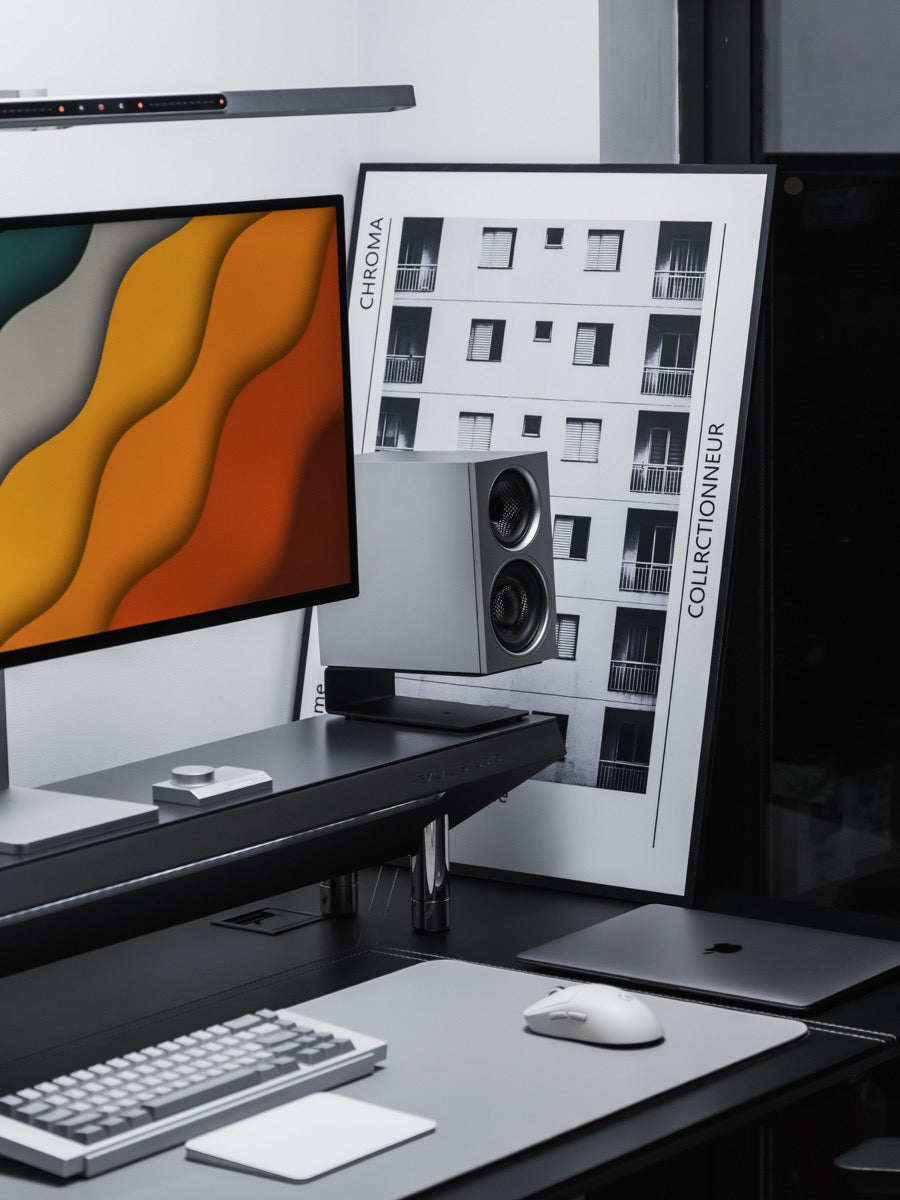
MiniMax3 Monitor is 195 × 110 × 200 mm — 200 mm deep, which is what determines whether it fits the budget from step 1 — and about 4.1 kg in an aluminium cabinet.
Its driver complement is a 1″ silk dome tweeter mounted coaxially inside a 3″ carbon-fibre midrange, a 3.5″ carbon-fibre woofer and a 5″-equivalent passive radiator: 3-way, 4-driver. By diameter alone the 3.5″ woofer sits at the small end of the table in section 2, and it reaches 49 Hz (−3 dB) and 46 Hz (−6 dB) because it reproduces only bass, with the midrange handled separately and extension provided by the radiator — the section 4 argument, implemented.
The coaxial geometry addresses the driver-spacing issue directly, since tweeter and midrange occupy one point on the baffle rather than two. At 110 mm wide it is the most compact 3-way coaxial desktop monitor we know of. Measurements are published as a CTA-2034 spinorama from a Klippel near-field scanner.
Related: Desktop speakers vs bookshelf speakers · Two-way vs three-way studio monitors · How to choose a compact studio monitor
Frequently asked questions
What size speaker is best for a small desk?
For a desk under 700 mm deep with a listening distance under a metre, a 3–4 inch woofer is usually right, with 5 inches as a practical maximum.
Are 5 inch monitors too big for a desk?
Not always, but they are typically 230–280 mm deep, which is the dimension that causes problems on a shallow desk, and their wider driver spacing integrates less well at close range.
Is a 3 inch speaker enough for a desk?
For near-field listening, usually yes. At desk distance you need far less output than in a room, and cabinet alignment affects extension more than an inch of diameter does.
Does a bigger woofer mean better sound?
It means more output and usually more extension. Accuracy, imaging and tonal balance come from the crossover, cabinet and driver quality, and on a desk from placement.
How do I measure how much space I have for speakers?
Take the desk depth, subtract the display stand's depth, then subtract about 100 mm for the keyboard and your forearms.
Sources and editorial notes
- Consumer Technology Association — ANSI/CTA-2034-B measurement standard overview
- SOVOX MiniMax3 Monitor — current specifications and measurements
- SOVOX — two-way vs three-way studio monitors
- SOVOX — how to choose a compact studio monitor
Editorial policy: SOVOX manufactures a monitor with a 3.5″ woofer and argues here that driver diameter is a poor primary criterion — a position that favours our own design. The reasoning is set out in full so it can be evaluated, and the cases where a larger driver is correct are given in section 2.
MiniMax3 product-specific values were checked against the current SOVOX product page on August 24, 2026.
Share:
Desktop Speakers vs Bookshelf Speakers on a Desk
Studio Monitors vs Computer Speakers: Which Belongs on Your Desk