
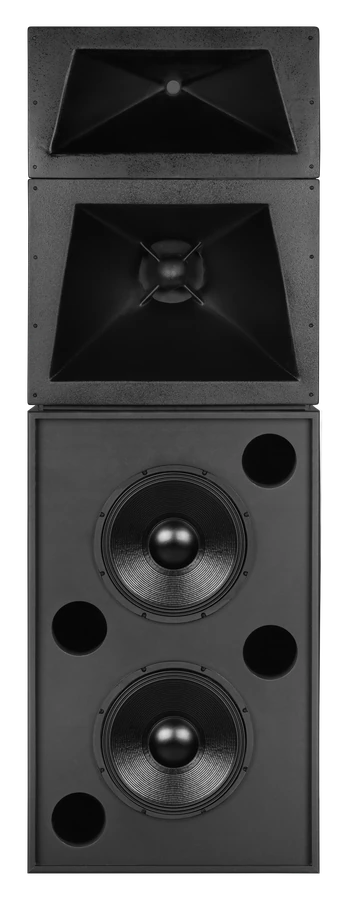
MV3108PRO
Cinema Screen Loudspeaker System
High-output three-way, bi-amplified screen-channel system with dual 18-inch LF and a horn-loaded 10-inch midrange, plus a 3-inch compression driver. Profondeur de salle ≤ 24 m/33 m1
Behind-screen main channels · Large commercial auditoriums · Large-format screens
Caractéristiques
- Dual 18-inch LF module provides ample low-frequency radiating area and sustained output capacity.
- Dedicated 10-inch midrange uses a 75 mm voice coil and a rigid cast-aluminium chassis for the dialogue band.
- 3-inch compression driver with HLMS™ dual shorting rings (copper sleeve + aluminium ring) for mid-high distortion control at high output.
- 100° × 20°–30° nominal coverage; the LF module, 10-inch midrange horn and 3-inch HF horn share a matched 760 mm width for a flush, consistent acoustic line-up behind the screen.
- Bi-amplified drive: 300 Hz LR24 active and 1 kHz passive crossovers coordinate the three bands, with independent amplifier channels for LF and mid/high.
- The mid/high module is moulded in lightweight polymeric material (approx. 23 kg net); the stacked, separable structure eases transport and allows staged installation and separate service access.
Présentation
The MV3108PRO is a high-output three-way, bi-amplified screen channel system in the SOVOX MV Series for large auditoria and longer projection distances, covering behind-screen main channels as well as large commercial auditoria and large-format screens. It pairs a dual-18-inch low-frequency module with a horn-loaded mid/high module carrying a 10-inch midrange and a 3-inch compression driver; the LF module is 760 mm wide, and the system covers 40 Hz–20 kHz (±3 dB, half-space) with a 30 Hz–20 kHz usable range and 100° × 20°–30° nominal coverage.
Twin 18-inch low-frequency drivers use ADM™ oil-treated tight-pressed cones, and the module’s 102 dB sensitivity (1 W/1 m, 2π) helps ease the load on each amplifier channel. A dedicated 10-inch midrange on a rigid cast-aluminium chassis carries the dialogue band, and the 3-inch titanium-diaphragm compression driver uses the HLMS™ copper-sleeve-plus-aluminium-ring dual shorting structure. The system crosses over actively at 300 Hz (LR24), with independent amplifier channels for the low-frequency and mid/high sections and a 1 kHz passive network inside the mid/high module linking the midrange to the high frequencies. The 10-inch midrange horn and the 3-inch HF horn match the low-frequency module’s 760 mm width, keeping the acoustic frontage behind the screen flush — a layout intended to support consistent sound-pressure distribution and dialogue clarity across broad seating areas. The mid/high horn is moulded in lightweight polymeric material (approx. 23 kg net), which eases transport and installation.
Spécifications
| Product Type | Cinema Screen Loudspeaker System | |
|---|---|---|
| System Type | 3-Way, Bi-Amplified | |
| Frequency Response (±3 dB @ 2π)2 | 40 Hz–20 kHz | |
| Frequency Range (-10 dB @ 2π)2 | 30 Hz–20 kHz | |
| Coverage Angle (H×V) | 100° × 20°–30° | |
| M380(W)LF MODULE | MV3105PRO(T)MF / HF MODULE | |
| Driver Configuration | 18"LF × 2 | 10"MF + 3"HF |
| Nominal Impedance | 4Ω | 8Ω |
| AES 100-Hour Power Rating3 | 1200W | 300W |
| AES 2-Hour Power Rating | 1500W | 375W |
| Program Power4 | 2400W | 600W |
| Sensitivity (2π) @1W/1m | 102dB | 104dB |
| Rated Maximum SPL /1m @ 2π | 132.8dB | 128.8dB |
| Calculated Maximum SPL /1m @ 2π5 | 138.8dB | 134.8dB |
| Crossover Frequency | LR-24 dB/oct @300 Hz (LF–MF HF) | 1 kHz passive (MF–HF) |
| Recommended HPF | 25 Hz, LR24 | - |
| Enclosure Type | Bass-reflex enclosure | Mid-frequency horn + high-frequency horn |
| Enclosure Material / Finish | MDF · PVC | Polymeric MDI · Textured paint |
| Input Connectors | Binding posts | Binding posts |
| Mounting Options | Screen-frame mounting | Mounted on top of the LF module |
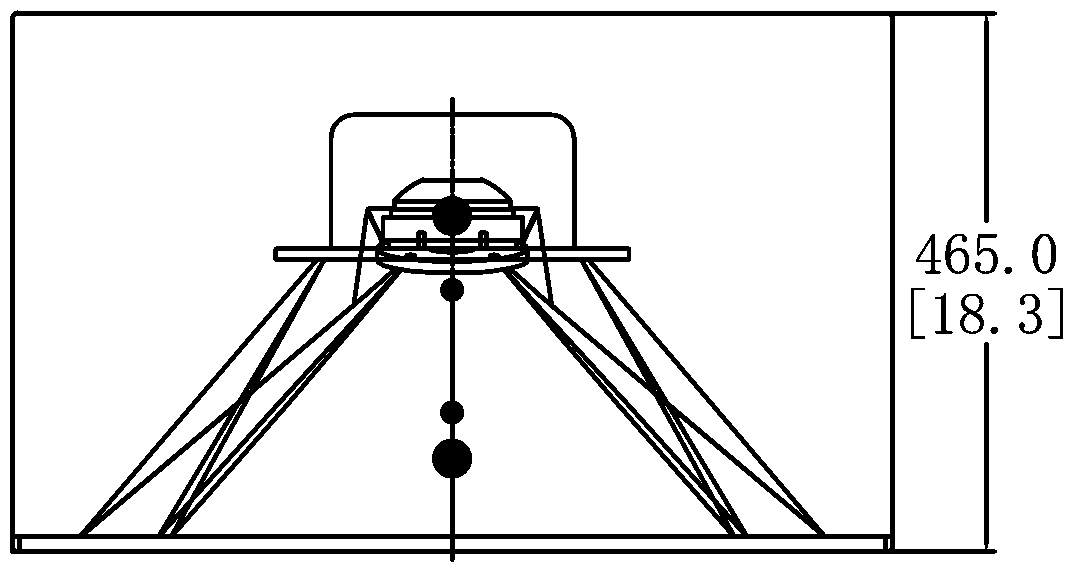
| Dimensions W×H×D (mm) | W760 × H1202 × D571.5 mm | W760 × H713 × D570 mm |
| Net Weight | 72 kg | 23 kg |
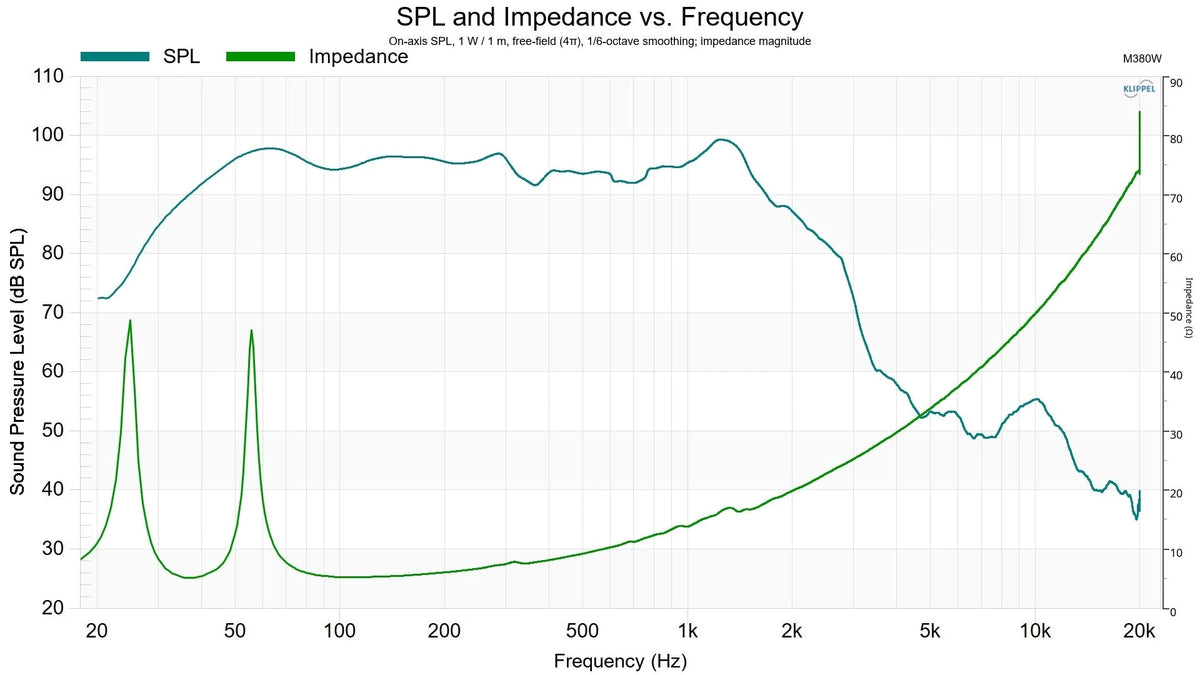
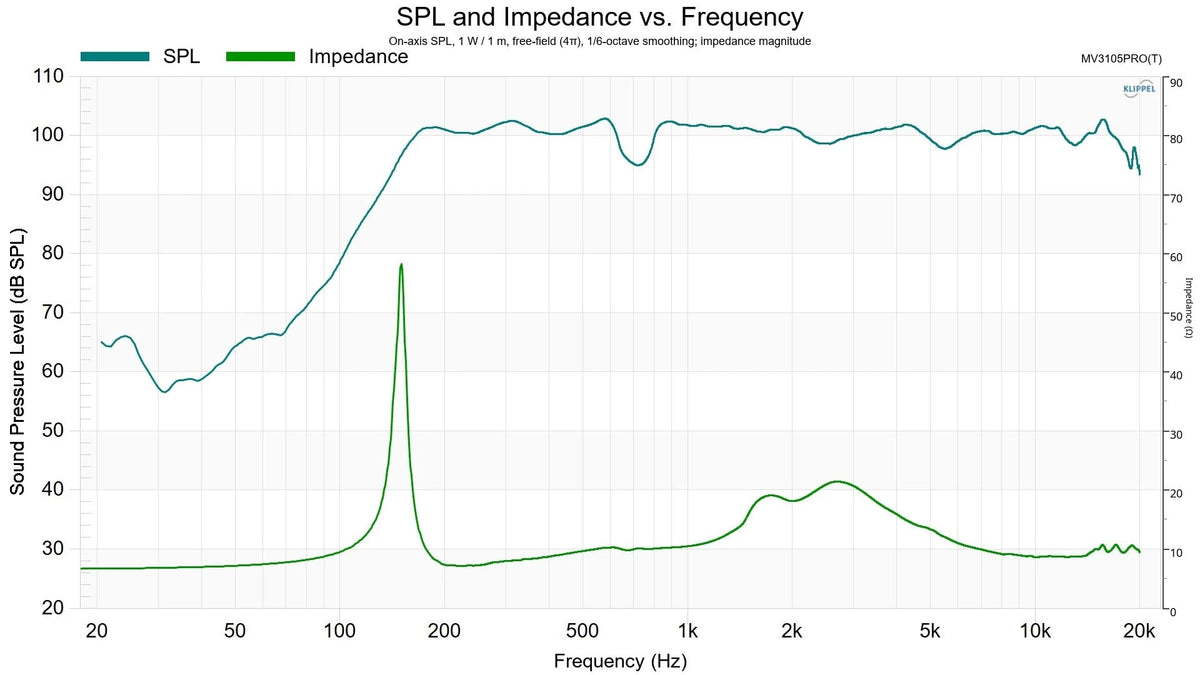
Réponse en fréquence
Dimensions


- 1Two length values are given: the first is the usable range on continuous power, the second on program power. Program power is a short-term maximum output and is not a level the system can sustain continuously. Target levels follow the SMPTE ST 202 / RP 200 cinema reference level: 85 dB for screen channels plus 20 dB peak headroom, measured at the reference listening position (RLP); hall depth = listening distance x 1.5. Listening distance is derived from free-field distance attenuation. The continuous-power range uses the rated maximum SPL in this table; the program-power range uses the rated value +3 dB (program power being twice the continuous power). The calculated maximum SPL (rated +6 dB, short-term peak) is not used for these figures. Screen loss, power compression, system limiting and room gain are not included - this is a theoretical estimate, not a measured guarantee; on-site verification is recommended. Operating beyond the recommended figure may result in, but is not limited to: dynamic compression, increased distortion, extraneous noise, and in severe cases equipment damage.
- 2Low-frequency response and sensitivity specifications are referenced to half-space (2π) conditions, representative of typical cinema baffle-wall installation. Frequency-response graphs are measured in an anechoic free-field (4π) environment unless otherwise noted. In the low-frequency region the same loudspeaker measures about 6 dB higher under 2π than under 4π (in practice 3–6 dB depending on frequency and baffle conditions); this is a difference of measurement convention, not of performance.
- 3Rating based on an IEC filtered random-noise test signal, band-limited 50 Hz–20 kHz, with a peak-to-average ratio of 6 dB
- 4Recommended amplifier output at the applicable impedance should not exceed the program power, giving an unclipped output waveform while avoiding loudspeaker damage; an amplifier capable of at least the RMS continuous power (AES 100 h) is recommended to realize full loudspeaker performance. The actual amplifier match should be determined by calculation for the listening distance (see note 1).
- 5Calculated maximum SPL is derived from the rated (continuous) power and half-space (2π) sensitivity and is a calculated, not measured, figure; at a 6 dB peak-to-average ratio it exceeds the rated value by 6 dB, representing short-term peak capability rather than a level the system can sustain.
- 6The frequency-response graphs on this page are measured on-axis at 1 W/1 m in an anechoic free-field (4π) environment with 1/6-octave smoothing; the frequency response and sensitivity in the specification table are stated under half-space (2π) conditions. Lower readings in the low-frequency region of the graph therefore reflect the difference in convention rather than a difference in performance. 2π-format curves are available on request.
Plus de systèmes de canal d'écran
Les 21 modèles