
By SOVOX Engineering · Published August 24, 2026 · Technical details checked August 24, 2026
The short answer
A port and a passive radiator both form a resonator with the air in the cabinet, extending low-frequency output below what the woofer manages alone. Ignoring losses, the two are theoretically equivalent — the port uses a slug of air as its mass element and the radiator uses a diaphragm.
The differences are practical, and they grow as the cabinet shrinks: a port small enough to fit a compact enclosure may be narrow enough to produce audible turbulence, and a port needs clearance behind it that a desk against a wall often cannot provide.
Scope and disclosure
This guide compares sealed, ported and passive-radiator alignments for compact active nearfield speakers. It focuses on the desktop case rather than subwoofers in rooms, and it treats the choice as a system-level trade-off rather than a ranking.
Disclosure: SOVOX publishes this article and manufactures a sealed monitor using a passive radiator. The drawbacks of that alignment are listed below alongside its advantages, and cases where a port is the better choice are named.
1. The physics the two share
A sealed cabinet acts as a spring: the air inside resists the woofer's motion, and below the point where that spring dominates, output falls away gently.
A ported cabinet adds an opening with a tube. The mass of air in the tube, working against the compliance of the air in the box, forms a Helmholtz resonator. Tuned near the bottom of the woofer's range, the port radiates in phase with the woofer through the tuning region and adds output.
A passive radiator replaces that slug of air with a diaphragm — a cone or disc with a suspension, no voice coil, no magnet — driven by pressure inside the cabinet. Its moving mass and suspension compliance set the resonance exactly as the port's air mass and box compliance do.
Same resonator, different mass element. Both roll off steeply below tuning, because both leave the woofer working against little loading.
2. Where a port runs out of room
To tune a small box low, a port must be narrow or long, and both cause problems.
Narrow ports produce turbulence. Port air velocity rises as the port gets smaller. Past roughly 5% of the speed of sound the flow stops being smooth and becomes audible as a breathy chuffing on bass notes, worse at higher levels. This is the most common failure of a compact ported speaker.
Long ports do not fit. Keeping velocity down means a wider port, and a wider port must be longer to reach the same tuning. In a cabinet 200 mm deep, a port long enough to tune into the low 40 Hz region at a sensible diameter may not physically fit, and folding it introduces turbulence at the bends.
Ports have their own resonances. A tube has harmonics, and a port also leaks midrange energy from inside the cabinet straight out through the opening.
A passive radiator avoids all three. It is tuned by adding mass rather than by extending a tube, so tuning low costs grams rather than centimetres; there is no aperture moving air at speed, so there is no chuffing at any level; and the cabinet stays sealed, so internal midrange energy stays inside.
3. What a passive radiator costs
- Money. A radiator is a manufactured component with a cone, surround and suspension. A port is an opening and sometimes a tube.
- Excursion limits. A radiator has finite travel, and exceeding it drives the suspension non-linear. The failure is more abrupt than a port's gradual turbulence.
- Its own compliance. A suspension is not perfectly linear and changes with temperature and age. A port's air mass does not.
- A notch below tuning. As with any resonant system there is a frequency where the radiator moves out of phase with the woofer and cancels. Well below the passband in a good design, but present.
- Fixed tuning. You cannot plug a passive radiator to move the alignment toward sealed, as you can with a port.
4. The part that matters on a desk
A port needs clearance. A passive radiator does not.
A rear-firing port close to a wall is obstructed: air cannot move freely, tuning shifts, and the boundary reinforces the port output unpredictably. The standard instruction is to leave 20–30 cm behind a rear-ported speaker.
On a desk against a wall that clearance frequently does not exist. And as speakers close to a wall on a desk works through, the arithmetic often says a desk speaker is better off very close to the wall — close enough that the first boundary cancellation lands above the bass region, leaving reinforcement that can be corrected rather than a null that cannot.
A ported speaker cannot take that advice. A sealed cabinet with a passive radiator can, because there is no aperture to obstruct. That makes the alignment partly a placement decision, and on a desk placement dominates most other variables.
5. Choosing between the three alignments
| Sealed | Ported | Passive radiator | |
|---|---|---|---|
| Low-end output | Least | Most | Between, nearer ported |
| Roll-off below tuning | Gentle | Steep | Steep |
| Noise at high level | None | Chuffing possible | None |
| Cost | Lowest | Low | Highest |
| Cabinet volume needed | Largest | Small | Least of the three |
| Wall clearance required | Any | Needs clearance | Any |
| User-adjustable | n/a | Plug the port | No |
- Large cabinet, cost-sensitive: ported. There is room for a well-sized port.
- Very small cabinet, low bass wanted: passive radiator. A port will not fit at a diameter that stays quiet.
- Accuracy over extension, space available: sealed. Fewest variables.
- Speaker going against a wall: sealed or passive radiator.
6. A worked example
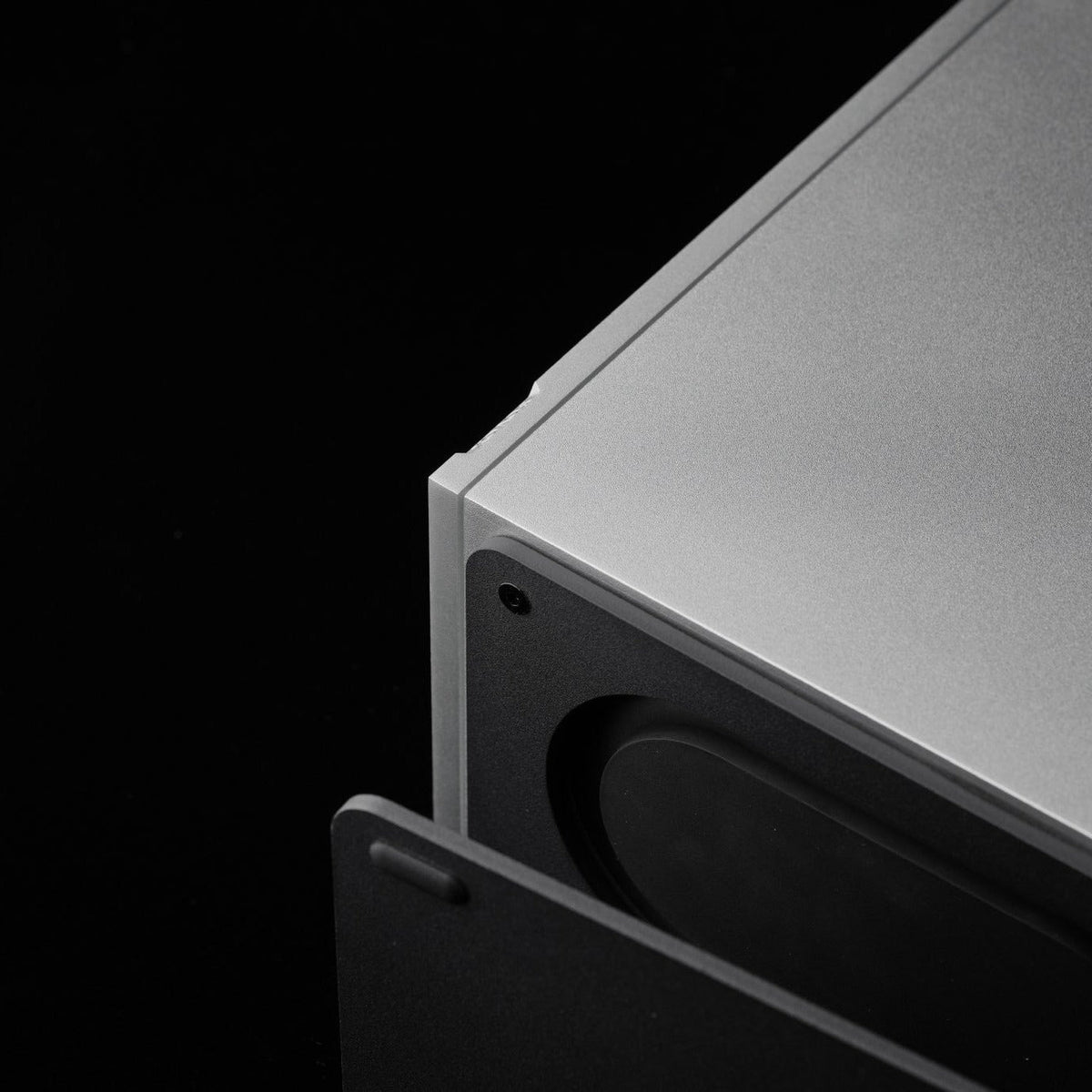
MiniMax3 Monitor uses a 5″-equivalent passive radiator in a sealed aluminium cabinet of 195 × 110 × 200 mm, with no port. At that internal volume, a port tuned low enough to be useful would need to be narrow enough to chuff or long enough not to fit; the radiator tunes by mass instead of length.
It counts toward the driver total — the external convention is 3-way, 4-driver: three driven units plus the radiator. It is not a crossover point, because it is not driven.
Low-frequency limit is 49 Hz (−3 dB) and 46 Hz (−6 dB), published as a CTA-2034 spinorama measured on a Klippel near-field scanner. The practical consequence on a desk is that with no port to keep clear, the speaker can sit as close to the wall behind it as the desk requires.
Related: Speakers close to a wall on a desk · Two-way vs three-way studio monitors · How to choose a compact studio monitor
Frequently asked questions
What is a passive radiator in a speaker?
An undriven diaphragm with a suspension but no voice coil or magnet, moved by pressure inside the cabinet. It forms a resonance with the enclosed air in the same way a port does.
Is a passive radiator better than a port?
Not fundamentally — ignoring losses the two alignments are theoretically equivalent. A radiator avoids port turbulence and needs no clearance, at higher cost and with a fixed tuning.
Why do small speakers use passive radiators?
Because a port tuned low enough for a small cabinet often has to be either narrow enough to produce audible turbulence or too long to fit.
Can you put a passive radiator speaker against a wall?
Yes. A sealed cabinet with a passive radiator has no aperture to obstruct, so tight placement does not shift its tuning the way it does for a rear-ported design.
What is port chuffing?
Audible turbulence when air velocity through the port becomes too high, heard as a breathy noise on bass notes that worsens with level.
Sources and editorial notes
- Consumer Technology Association — ANSI/CTA-2034-B measurement standard overview
- SOVOX MiniMax3 Monitor — current specifications and measurements
- Erin's Audio Corner — independent MiniMax3 measurements and review
- SOVOX — speakers close to a wall on a desk
Editorial policy: SOVOX manufactures a sealed monitor with a passive radiator. The drawbacks of that alignment are listed explicitly, the theoretical equivalence of port and radiator is stated up front, and the cases where a port is preferable are named.
MiniMax3 product-specific values were checked against the current SOVOX product page on August 24, 2026.
Compartir:
USB Speakers vs an External DAC: What Actually Changes
Desktop Speakers vs Bookshelf Speakers on a Desk