
By SOVOX Engineering · Published August 24, 2026 · Technical details checked August 24, 2026
The short answer
A bookshelf speaker is designed for a distance of two to three metres, usually needs a separate amplifier, and is typically 250–300 mm deep. A near-field desktop monitor is designed for 0.6–1.2 m, is usually active, and is shallower.
The deciding factor is design distance, not quality. A bookshelf speaker used at desk distance is being asked to work at a quarter of the distance it was designed for, and its driver spacing shows that up before anything else does.
Scope and disclosure
This guide compares passive bookshelf speakers with active near-field monitors for desktop use. It does not rank models, and it identifies the cases where a bookshelf speaker on a desk is the right answer.
Disclosure: SOVOX publishes this article and manufactures a compact near-field monitor. The article states that bookshelf speakers are frequently better speakers at similar money, and lists the situations in which one is the better desktop choice.
1. The categories, deflated
Bookshelf speaker usually means a two-way box 250–400 mm tall, meant for a stand or shelf at two to three metres, usually passive. It is named for where people put it, not for a design characteristic.
Desktop speaker means anything intended to sit beside a computer — an enormously broad category running from plastic USB pairs to professional monitors.
Near-field monitor is the useful category the other two names obscure: a speaker engineered specifically for 0.6–1.2 m. That is a design parameter rather than a size class, and it is what a desk calls for. Studio monitors vs computer speakers covers that distinction.
So the real question is not bookshelf or desktop. It is whether the speaker was designed for the distance you will use it at.
2. Depth is the constraint, not width
People measure a speaker's width against their desk and conclude it fits. Depth decides it.
A typical bookshelf speaker is 250–300 mm deep. On a 600 mm desk, with clearance behind, it consumes half the working surface. The display ends up behind the speakers rather than between them, or the speakers sit forward of the display — and either way the geometry is wrong. It also shortens the listening distance, often to well under what the speaker was designed for, and narrows the separation, collapsing the stereo triangle.
Measure depth first. If speakers plus clearance take more than a third of your desk depth, the rest of this comparison is academic. What size speaker for a small desk works through the arithmetic.
3. Distance: you are probably too close
A bookshelf speaker's drivers are typically 150–200 mm apart vertically, on the assumption that you sit two to three metres away, where that separation subtends a small angle and the drivers integrate into a single apparent source.
At 700 mm the same separation subtends a much larger angle. The result is a less focused centre image and a tonal balance that shifts with small head movements. This is not a defect; it is a speaker being used at a quarter of its design distance. It is also the strongest argument for a purpose-built near-field design, and the reason driver geometry matters so much more up close — see what is a coaxial speaker.
4. Passive means another box, and an unknown pairing
Most bookshelf speakers are passive and need an amplifier: another unit on or under the desk, speaker cable to both sides, another supply, another thing to switch on. For many desks that settles it on its own.
There is a subtler point. A passive speaker paired with an arbitrary amplifier is two designers' assumptions meeting for the first time — the crossover was designed expecting a particular source impedance, the amplifier expecting a particular load. Usually fine, occasionally not, and when it is not the symptom is a tonal shift nobody can locate. An active design has the amplifier matched to each driver by the person who designed both, with the crossover applied before amplification.
5. The wall behind punishes a larger speaker harder
A bookshelf speaker produces more bass, which on a desk against a wall is not straightforwardly good. Every nearby boundary raises low-frequency output, and a desk against a wall provides at least two. A speaker already generous at 60 Hz, reinforced by two surfaces, becomes uneven rather than simply fuller.
Most bookshelf speakers are also rear-ported, and a rear port needs 20–30 cm of clearance. On a desk against a wall you rarely have it, so tuning shifts and the bass the speaker was chosen for arrives unpredictably. The mechanism is in speakers close to a wall on a desk; the short version is that more extension into a poor boundary situation enlarges the problem rather than solving it.
6. When a bookshelf speaker is right on a desk
- A deep desk — 750 mm or more — where depth is not the binding constraint.
- You sit well back, 1.2 m or more, which happens with large displays.
- The desk is away from a wall, so boundary effects are mild and a rear port has room.
- You already own them and an amplifier. The cheapest good sound is often the sound you already have, correctly placed — do the placement work before spending anything.
- They are shallow and front-ported, which removes two of the four objections at once.
7. When a near-field design is right
Desk under 700 mm deep; you sit under a metre away; the desk is against a wall; you do not want an amplifier on the desk; and you want the tonal balance to stay put when you move your head. That describes most desks.
| Bookshelf | Near-field desktop | |
|---|---|---|
| Design distance | 2–3 m | 0.6–1.2 m |
| Typical depth | 250–300 mm | 150–220 mm |
| Amplification | Usually passive | Usually active |
| Driver spacing at desk distance | Wide for the distance | Designed for it |
| Boxes on the desk | Speakers + amplifier | Speakers |
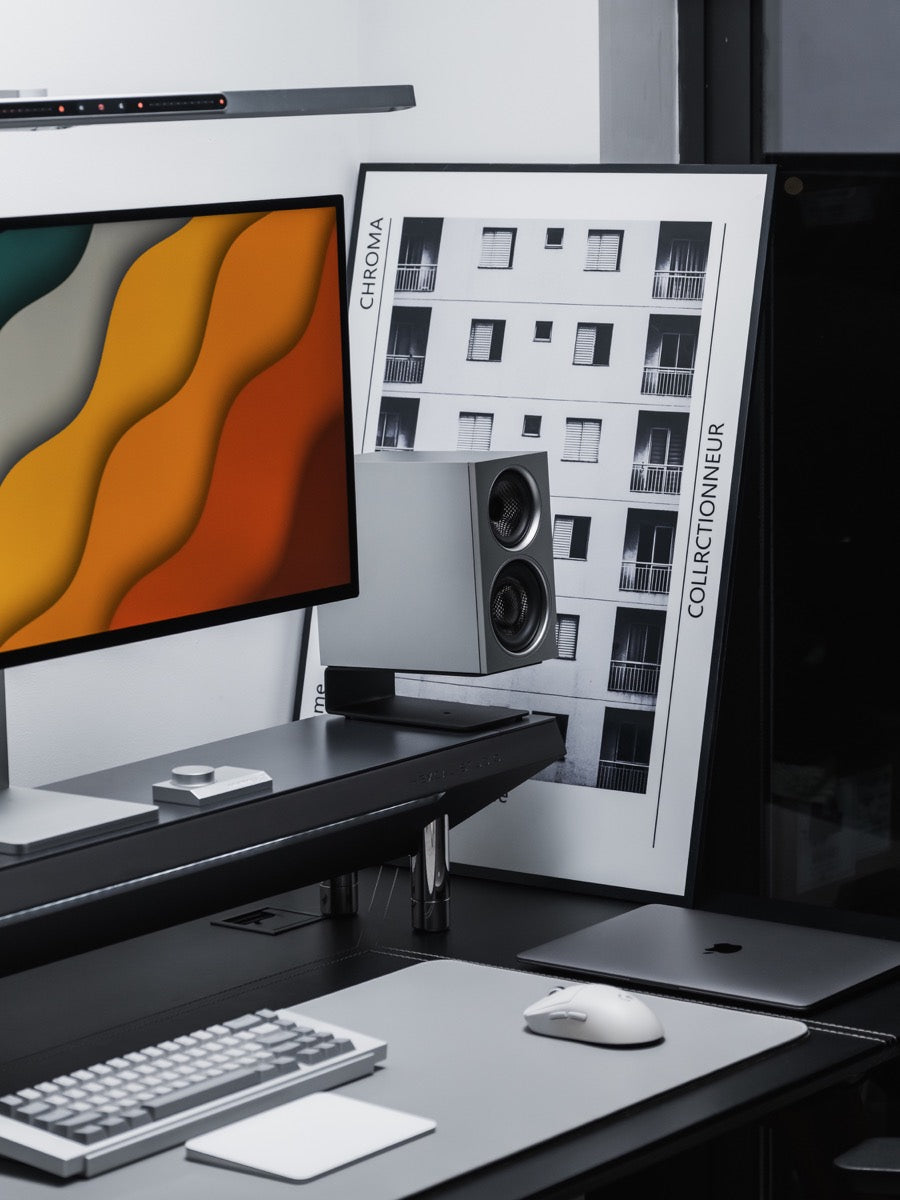
For reference, MiniMax3 Monitor is 195 × 110 × 200 mm — 200 mm deep, which is the dimension that decides desk fit — and about 4.1 kg. It is active, with a separate amplifier per band and the crossover in DSP, so no amplifier needs desk space. As a 3-way, 4-driver coaxial design the tweeter is mounted inside the midrange, so the driver-spacing problem in section 3 does not arise at desk distance. The cabinet is sealed with a 5″-equivalent passive radiator rather than ported, so section 5's clearance requirement does not apply. Low-frequency limit is 49 Hz (−3 dB) and 46 Hz (−6 dB).
Related: What size speaker for a small desk · Where to put small studio monitors on a desk · How to choose a compact studio monitor
Frequently asked questions
Can you use bookshelf speakers on a desk?
Yes, if the desk is deep enough, you sit far enough back, and there is room behind a rear port. On a shallow desk against a wall the design distance and the port clearance both work against you.
Are bookshelf speakers better than computer speakers?
At similar money they are usually better speakers in isolation. That does not make them the better choice at desk distance, which is a different question.
How deep should a desktop speaker be?
Measure your desk depth, subtract the display stand and about 100 mm of working room. Whatever remains is the budget, and depth is published less prominently than width or height.
Do bookshelf speakers need an amplifier?
Most do. Active near-field monitors have amplifiers built in, which is why they need no separate box on the desk.
Does more bass extension help on a desk against a wall?
Not necessarily. Nearby boundaries already reinforce low frequencies, so a speaker with more output down low can make the unevenness more obvious rather than less.
Sources and editorial notes
- SOVOX MiniMax3 Monitor — current specifications and measurements
- SOVOX — where to put small studio monitors on a desk
- SOVOX — speakers close to a wall on a desk
Editorial policy: SOVOX manufactures a compact near-field monitor. The article concedes that bookshelf speakers are frequently better speakers at similar money and lists the desk conditions under which one is the better choice.
MiniMax3 product-specific values were checked against the current SOVOX product page on August 24, 2026.
Partager:
Passive Radiator vs Port: How Small Speakers Get Real Bass
What Size Speaker Do You Need for a Small Desk?