
By SOVOX Engineering · Published August 24, 2026 · Technical details checked August 24, 2026
The short answer
A coaxial loudspeaker places two or more drivers on the same axis so they radiate from effectively the same point rather than from positions separated on a baffle. The main benefit is more consistent response as you move off-axis, particularly vertically.
The word describes two very different engineering projects. In car audio it usually denotes an inexpensive, easy-to-fit driver. In studio monitoring it usually denotes a deliberate point-source design that raises cost. This guide is about the second.
Scope and disclosure
This guide explains coaxial and concentric driver geometry as used in compact active nearfield monitors. It treats coaxial packaging as one implementation method rather than a guarantee of performance, and it points to measured directivity as the final test.
Disclosure: SOVOX publishes this article and manufactures a three-way coaxial monitor using a patented ISP™ architecture, used below as a concrete example. Independent measurements are linked so the claims can be checked outside SOVOX's own material.
1. The problem coaxial geometry addresses
In a conventional monitor the tweeter sits above the woofer, perhaps 150 mm away. Around the crossover frequency both drivers produce sound at similar levels, and their outputs sum in the air. Whether they sum constructively or destructively depends on the difference in path length from each driver to your ear — and that difference changes as you move.
Sit level with the point between them and the path lengths match. Move your head up and you are closer to the tweeter. At 3 kHz a wavelength is roughly 114 mm, so only a few centimetres of path difference is needed to shift the relative phase enough to produce a response notch.
This is lobing. It means a vertically separated two-driver design does not have one frequency response; it has a different one at every vertical angle. Placing the tweeter at the acoustic centre of the midrange equalises the path lengths in every direction at once, which makes the off-axis response a smoother version of the on-axis response rather than a different curve.
2. Why the benefit scales with how close you sit
Coaxial geometry helps at any distance, but its value rises sharply at short ones.
At three metres, 150 mm of driver separation subtends a small angle and a 100 mm head movement barely changes it. At 700 mm — normal desk distance — the same separation subtends a much larger angle, so leaning toward the screen or sitting back moves you through a meaningfully different part of the radiation pattern. Most people do not identify this as a speaker characteristic; they experience the sound as unsettled, or never quite find the right chair height.
There is a second desk-specific effect. A coaxial radiates symmetrically about its axis, so reflections from the desk surface, the display and the wall behind arrive with the same tonal character as the direct sound. Those reflections still cause problems — see speakers close to a wall on a desk — but they at least sound like the speaker rather than a filtered version of it.
3. Why coaxial designs are difficult to build
The midrange cone becomes a waveguide. The tweeter fires through the middle of a moving cone whose profile changes with excursion. Get it wrong and the tweeter's response is modulated by what the larger driver is doing. Getting it right means designing the cone profile and the tweeter exit as one component.
The motor structures compete for space. Two magnet systems occupy the same volume and their fields interact. Resolving that consumes space, mass and cost.
Doppler modulation is present in principle. The tweeter is mounted to a surface that moves, which frequency-modulates the high frequencies. The effect is small at sensible levels and in designs where the coaxial driver's excursion is limited — one reason a three-way coaxial has an easier problem than a two-way one.
4. Two-way coaxial versus three-way coaxial
In a two-way coaxial the tweeter is mounted in a driver that also reproduces bass, so excursion is large, the waveguide moves more, and the crossover has to sit where the woofer's limits allow rather than where it acoustically belongs.
In a three-way coaxial the tweeter is mounted in a dedicated midrange that is crossed out of the bass entirely. Excursion is small, the mounting surface is comparatively stable, and the upper crossover can be placed on acoustic grounds. The cost is a third driver, a third amplifier path, a more complex filter and enclosure volume. Two-way vs three-way studio monitors covers that trade in detail.
5. What coaxial does not mean
- It is not a full-range driver. A full-range driver covers everything with one diaphragm; a coaxial is two or three drivers sharing an axis, each with its own band.
- It carries no price information. In car audio it usually indicates the budget option relative to a component set; in studio monitoring, frequently the opposite.
- It is unrelated to coaxial cable beyond the shared meaning of "same axis".
- It does not fix the room. It improves what leaves the speaker; what happens between the speaker and your ear is still the room's business.
6. How to evaluate one
- Is there off-axis data? Vertical off-axis response is the entire reason to build coaxially. A full CTA-2034 spinorama shows behaviour at every angle rather than only on-axis — see how to read a spinorama.
- Is the coaxial section reproducing bass? If it is a two-way, the tweeter is mounted in a driver at full excursion. Not disqualifying, but the harder problem.
- Where are the crossover points? A crossover placed to suit the drivers is different from one placed to work around them.
- How was it measured? Anechoic or quasi-anechoic data describes the speaker; in-room measurements describe the room it was measured in.
7. A concrete example
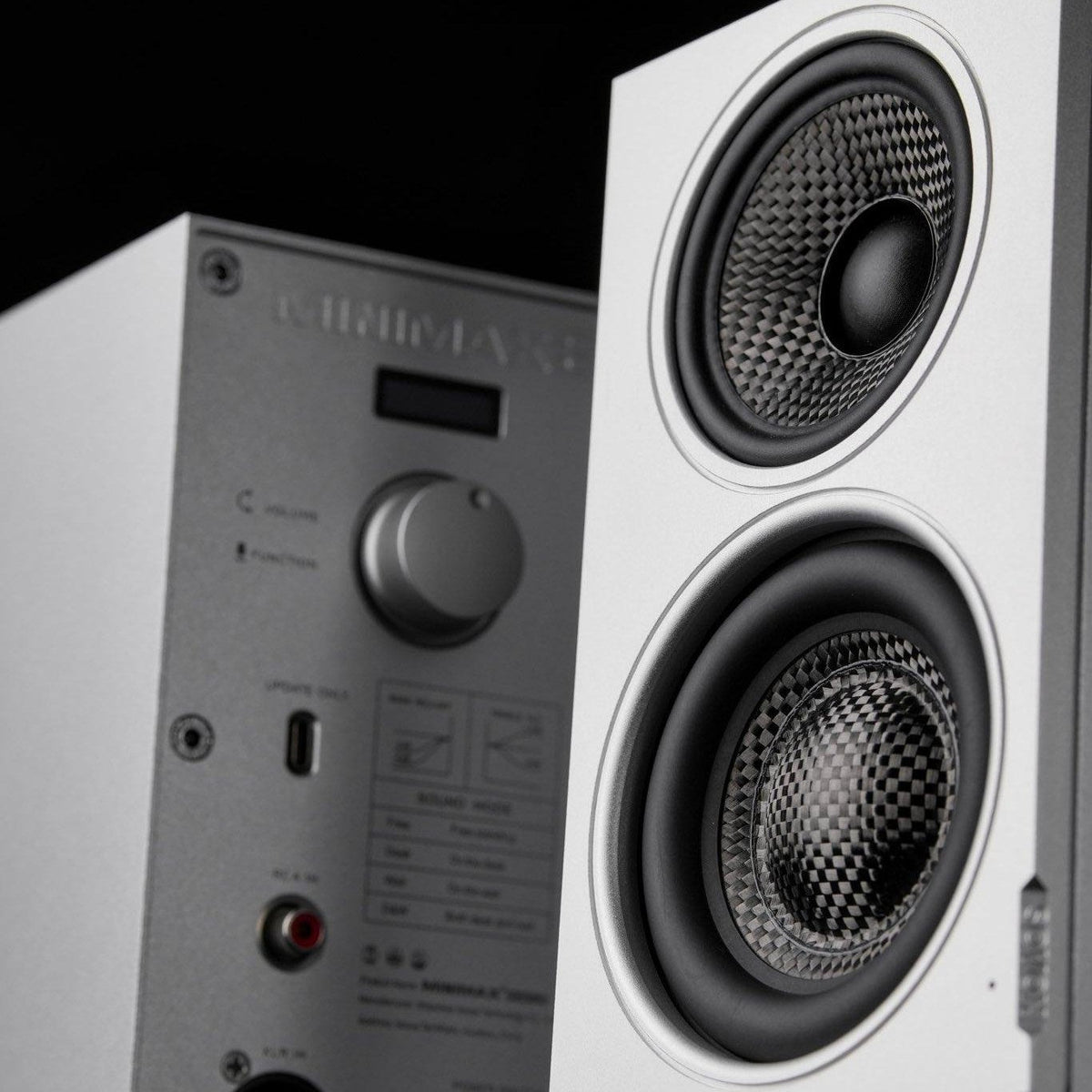
MiniMax3 Monitor is a 3-way, 4-driver design built on a patented ISP™ coaxial architecture: a 1″ silk dome tweeter with a 25 mm voice coil mounted coaxially inside a 3″ carbon-fibre midrange with a 26 mm voice coil, plus a separate 3.5″ carbon-fibre woofer and a 5″-equivalent passive radiator. Crossover points are 240 Hz and 3.6 kHz, third-order.
The coaxial section handles midrange and treble only; bass is the woofer's job and low-frequency extension is the passive radiator's, which keeps large excursion off the surface the tweeter is mounted to.
The aluminium cabinet is 195 × 110 × 200 mm. At 110 mm wide it is the most compact 3-way coaxial desktop monitor we know of — and at that width a conventional layout has little baffle area in which to separate a tweeter from a midrange without the lobing described in section 1 becoming severe at desk distance.
Low-frequency limit is 49 Hz (−3 dB) and 46 Hz (−6 dB). Measurements are published as a CTA-2034 spinorama from a Klippel near-field scanner, so the off-axis behaviour that justifies the architecture can be checked rather than taken on trust.
Related: Two-way vs three-way studio monitors · Compact 3-way coaxial monitors compared · How to read a spinorama
Frequently asked questions
What is a coaxial speaker?
A loudspeaker in which two or more drivers radiate from the same axis, so they behave more like a single point source than drivers separated on a baffle.
Are coaxial speakers better?
Coaxial geometry reduces source separation and can make off-axis response more consistent, especially vertically. It is a design method, not a guarantee — measured directivity is the test.
What is the difference between coaxial and component speakers?
That distinction comes from car audio, where coaxial means drivers combined in one assembly and component means separate tweeter and woofer. It does not map cleanly onto studio monitor design.
Why are coaxial drivers used in studio monitors?
Because near-field listening puts the listener close enough that driver separation subtends a large angle, making vertical off-axis consistency more important than it is at longer distances.
Does a coaxial driver remove the need for room treatment?
No. It changes what the speaker radiates; it does not change what the room does to that radiation.
Sources and editorial notes
- Consumer Technology Association — ANSI/CTA-2034-B measurement standard overview
- SOVOX MiniMax3 Monitor — current specifications and measurements
- SOVOX ISP™ coaxial technology
- Erin's Audio Corner — independent MiniMax3 measurements and review
Editorial policy: SOVOX manufactures a coaxial monitor and holds a patent on the architecture described. Coaxial geometry is presented here as a trade-off with named drawbacks, and independent measurements are linked so the performance claims can be verified externally.
MiniMax3 product-specific values were checked against the current SOVOX product page on August 24, 2026.
Partager:
Do You Need an Audio Interface for Studio Monitors?
Speakers Close to a Wall: Why Desk Setups Lose Their Bass