

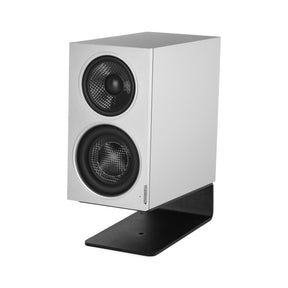
2 ทาง · พาสซีฟ

นโยบายการจัดส่ง · นโยบายทางกฎหมาย
M200T
ลำโพงหลักหลังจอสำหรับโรงภาพยนตร์
Compact พาสซีฟ two-way screen-channel loudspeaker with a single 12-inch woofer, for screening and dubbing rooms. ความลึกของโรงภาพยนตร์ ≤ 11 m/15 m1
การตอบสนองความถี่47 Hz – 20 kHz±3 dB @ 2π
มุมกระจายเสียง90° × 50°H × V
ระบบ2 ทาง · พาสซีฟ121.8 dB SPL สูงสุดพิกัด @ 1 ม., 2π
ความลึกของโรงภาพยนตร์≤ 11 m/15 mกำลังขับต่อเนื่อง / โปรแกรม
การใช้งาน
Behind-screen main channels · Small to medium commercial โรงภาพยนตร์s · Screening rooms · Private cinemas
01
คุณลักษณะเด่น
ประสิทธิภาพ
- Single 12-inch woofer with ADM™ loose-pressed paper cone and oil-treated cloth edge, balancing extension and efficiency.
- 2-inch titanium-diaphragm compression driver with integrated horn; 90° × 50° coverage aimed at the seating area.
วิศวกรรม
- Built-in 1.7 kHz พาสซีฟ crossover lets one amplifier channel drive the complete loudspeaker, with no external processor or crossover.
- 302 mm deep and 17.3 kg, suited to screening and dubbing rooms with limited screen-wall depth.
ความคุ้มค่าและการบำรุงรักษา
- 8 Ω nominal; one amplifier channel per enclosure, with same-side units paralleled or series-paralleled.
02
ภาพรวม
M200T คือลำโพงหลักหลังจอ 2 ทางแบบพาสซีฟขนาดกะทัดรัด สำหรับโรงภาพยนตร์ขนาดเล็กและมินิเธียเตอร์
รวมดอกวูฟเฟอร์ 15 นิ้วและฮอร์นทวีตเตอร์ไว้ในตู้เดียว ประหยัดพื้นที่หลังจอและติดตั้งได้สะดวกรวดเร็ว
03
ข้อมูลจำเพาะ
| ประเภทผลิตภัณฑ์ | ลำโพงหลักหลังจอสำหรับโรงภาพยนตร์ |
|---|---|
| ประเภทระบบ | 2 ทาง · พาสซีฟ |
| การจัดวางดอกลำโพง | 12"LF + 2"HF |
| ความต้านทานระบุ | 8Ω |
| การตอบสนองความถี่ (±3 dB @ 2π)2 | 47 Hz–20 kHz |
| ช่วงความถี่ใช้งาน (-10 dB @ 2π)2 | 36 Hz–20 kHz |
| กำลังขับ AES 100 ชั่วโมง3 | 300W |
| กำลังขับ AES 2 ชั่วโมง | 375W |
| กำลังขับโปรแกรม4 | 600W |
| ความไว (2π) @1 W/1 m | 97dB |
| ระดับความดันเสียงสูงสุดระบุ /1 m @ 2π | 121.8dB |
| ระดับความดันเสียงสูงสุดจากการคำนวณ /1 m @ 2π5 | 127.8dB |
| ความถี่ตัดข้ามครอสโอเวอร์ | 1.7 kHz พาสซีฟ |
| ฟิลเตอร์กรองความถี่สูงที่แนะนำ (HPF) | 30 Hz, LR24 |
| มุมกระจายเสียง (แนวนอน × แนวตั้ง) | 90° × 50° |
| ประเภทตู้ลำโพง | ตู้เปิดแบบเบสรีเฟล็กซ์ with built-in horn |
| วัสดุตู้ลำโพง / พื้นผิวสัมผัส | MDF · ลามิเนต PVC |
| ขั้วต่ออินพุต | ขั้วต่อไบนดิงโพสต์ |
| ตัวเลือกการติดตั้ง | ติดตั้งบนโครงจอภาพยนตร์ or suspended installation under guidance |
| ขนาด ก×ส×ล (mm) | W410 × H724 × D302 mm |
| น้ำหนักสุทธิ | 17.3 kg |
04
การตอบสนองความถี่

05
มิติขนาด


กว้าง × สูง × ลึก · น้ำหนักสุทธิW410 × H724 × D302 mm · 17.3 kg
- 1Two length values are given: the first is the usable range on continuous power, the second on program power. Program power is a short-term maximum output and is not a level the system can sustain continuously. Target levels follow the SMPTE ST 202 / RP 200 cinema reference level: 85 dB for screen channels plus 20 dB peak headroom, measured at the reference listening position (RLP); hall depth = listening distance x 1.5. Listening distance is derived from free-field distance attenuation. The continuous-power range uses the rated maximum SPL in this table; the program-power range uses the rated value +3 dB (program power being twice the continuous power). The calculated maximum SPL (rated +6 dB, short-term peak) is not used for these figures. Screen loss, power compression, system limiting and room gain are not included - this is a theoretical estimate, not a measured guarantee; on-site verification is recommended. Operating beyond the recommended figure may result in, but is not limited to: dynamic compression, increased distortion, extraneous noise, and in severe cases equipment damage.
- 2Low-frequency response and sensitivity specifications are referenced to half-space (2π) conditions, representative of typical cinema baffle-wall installation. Frequency-response graphs are measured in an anechoic free-field (4π) environment unless otherwise noted. In the low-frequency region the same loudspeaker measures about 6 dB higher under 2π than under 4π (in practice 3–6 dB depending on frequency and baffle conditions); this is a difference of measurement convention, not of performance.
- 3Rating based on an IEC filtered random-noise test signal, band-limited 50 Hz–20 kHz, with a peak-to-average ratio of 6 dB
- 4Recommended amplifier output at the applicable impedance should not exceed the program power, giving an unclipped output waveform while avoiding loudspeaker damage; an amplifier capable of at least the RMS continuous power (AES 100 h) is recommended to realize full loudspeaker performance. The actual amplifier match should be determined by calculation for the listening distance (see note 1).
- 5Calculated maximum SPL is derived from the rated (continuous) power and half-space (2π) sensitivity and is a calculated, not measured, figure; at a 6 dB peak-to-average ratio it exceeds the rated value by 6 dB, representing short-term peak capability rather than a level the system can sustain.
- 6The frequency-response graphs on this page are measured on-axis at 1 W/1 m in an anechoic free-field (4π) environment with 1/6-octave smoothing; the frequency response and sensitivity in the specification table are stated under half-space (2π) conditions. Lower readings in the low-frequency region of the graph therefore reflect the difference in convention rather than a difference in performance. 2π-format curves are available on request.
- 7Passive, single-amplifier-channel enclosure; hall depth above derived from its AES 100-hour rating and system sensitivity, with drive-unit-level verification pending.
ระบบ แชนเนลหลังจอ เพิ่มเติม
ครบทั้ง 21 รุ่น
127 DB

ES3264ระบบลำโพงหลักหลังจอสำหรับโรงภาพยนตร์
การตอบสนองความถี่โคแอกเชียล 2 ทาง · พาสซีฟ
มุมกระจายเสียง100° × 20°–30°
SPL สูงสุด125.8 dB (LF)
กำลังขับ AES 2 ชม.750 W (LF)
127 DB

ES3468ระบบลำโพงหลักหลังจอสำหรับโรงภาพยนตร์
การตอบสนองความถี่3 ทาง · ไบแอมป์
มุมกระจายเสียง100° × 20°–30°
SPL สูงสุดLF: 99 dB · MF/HF: 105 dB (LF)
กำลังขับ AES 2 ชม.LF: 600 W · MF/HF: 150 W (LF)
127 DB

ES3668ระบบลำโพงหลักหลังจอสำหรับโรงภาพยนตร์
การตอบสนองความถี่3 ทาง · ไบแอมป์
มุมกระจายเสียง100° × 20°–30°
SPL สูงสุดLF: 99 dB · MF/HF: 105 dB (LF)
กำลังขับ AES 2 ชม.LF: 600 W · MF/HF: 150 W (LF)
127 DB

ES3110ระบบลำโพงหลักหลังจอสำหรับโรงภาพยนตร์
การตอบสนองความถี่3 ทาง · ไบแอมป์
มุมกระจายเสียงLF: 1200 W · MF/HF: 300 W
SPL สูงสุดLF: 99 dB · MF/HF: 105 dB (LF)
กำลังขับ AES 2 ชม.LF: 600 W · MF/HF: 150 W (LF)