

By SOVOX Engineering · Published August 18, 2026 · Updated August 24, 2026 · Technical details checked August 24, 2026
The short answer
A two-way monitor uses one low/mid driver and one tweeter. A three-way adds a dedicated midrange, allowing the woofer, midrange and tweeter to work over narrower frequency ranges. That can reduce the excursion and bandwidth demanded from the driver reproducing the midrange and gives the designer more freedom over crossover points and directivity.
The trade-off is additional cost, amplifier/filter complexity and another crossover to integrate. Three-way is not automatically better than two-way. The useful question is whether the extra driver produces a measurable advantage in response, directivity, distortion or output for the intended listening distance.
Scope and disclosure
This guide explains the engineering differences between compact active two-way and three-way nearfield monitors. It does not rank every design by driver count, and it treats coaxial geometry as one implementation method rather than a guarantee of performance.
Disclosure: SOVOX publishes this article and manufactures a compact three-way coaxial monitor, MiniMax3 Monitor. The product is used below as a concrete design example. Independent measurements are linked so the claims can be checked outside SOVOX's own material.
What changes when you add a third way?
In a conventional two-way monitor, the woofer reproduces bass and midrange until it crosses to the tweeter. In a three-way, the woofer can hand the signal to a dedicated midrange at a lower frequency, and the midrange later hands it to the tweeter.
That creates three potential engineering benefits:
- Less low-frequency excursion in the midrange-producing driver. Bass requires much more cone displacement than midrange. Separating the jobs can reduce the modulation and mechanical demands placed on the driver reproducing voices and instruments.
- More freedom to choose driver size for each band. A woofer can be optimized for displacement, a midrange for controlled radiation through the vocal band, and a tweeter for the top octaves.
- More freedom over crossover placement. The designer is not forced to make one large low/mid driver meet one small tweeter at a single frequency. The two crossover regions can be chosen around the capabilities of three drivers.
Those benefits exist only if the added crossover and driver are integrated well. A poor three-way can have more response and directivity problems than a good two-way.
Why crossover frequency is not a simple “good zone / bad zone” question
Small two-way monitors commonly cross in the low-kilohertz region because that is where a woofer's upper-range directivity and a tweeter's lower operating range can be made to meet. That region is important to perceived timbre, but it is misleading to say that a crossover placed there is inherently audible or inherently bad.
A crossover is successful when the summed acoustic response, phase relationship and directivity remain controlled through the handoff. Modern waveguides, steep or shallow filters, DSP delay and careful driver selection can make an excellent two-way crossover. Likewise, simply moving a crossover higher does not guarantee a better result.
The practical test is the measurement: look for smooth on-axis response, a stable listening window and directivity that changes gradually through the crossover rather than developing a sudden discontinuity.
The extra challenge in a conventional three-way: source spacing
Adding a midrange normally creates a second transition between physically separated radiators. Around a crossover, both drivers contribute. As the listening angle changes, their path lengths change by different amounts, which can produce direction-dependent reinforcement and cancellation.
This is why driver spacing relative to wavelength, crossover slope and baffle geometry matter. A three-way gives the designer more degrees of freedom, but it also creates more integration work.
What coaxial geometry changes
A coaxial or concentric midrange-tweeter places the tweeter on the same axis as the midrange. That substantially reduces the physical source separation for the upper crossover compared with a conventional vertically separated pair.
The benefit is most visible in the radiation pattern: a well-executed coaxial can make horizontal and vertical behavior more similar and keep the listening window more consistent as the listener moves. It does not eliminate all crossover or directivity effects. The midrange cone can act as a waveguide for the tweeter, and cone shape, surround geometry, crossover filters and DSP still matter.

A concrete example: MiniMax3 Monitor
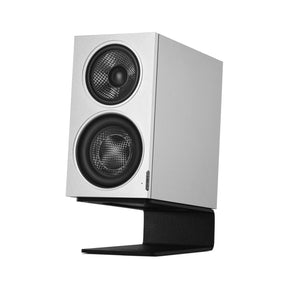
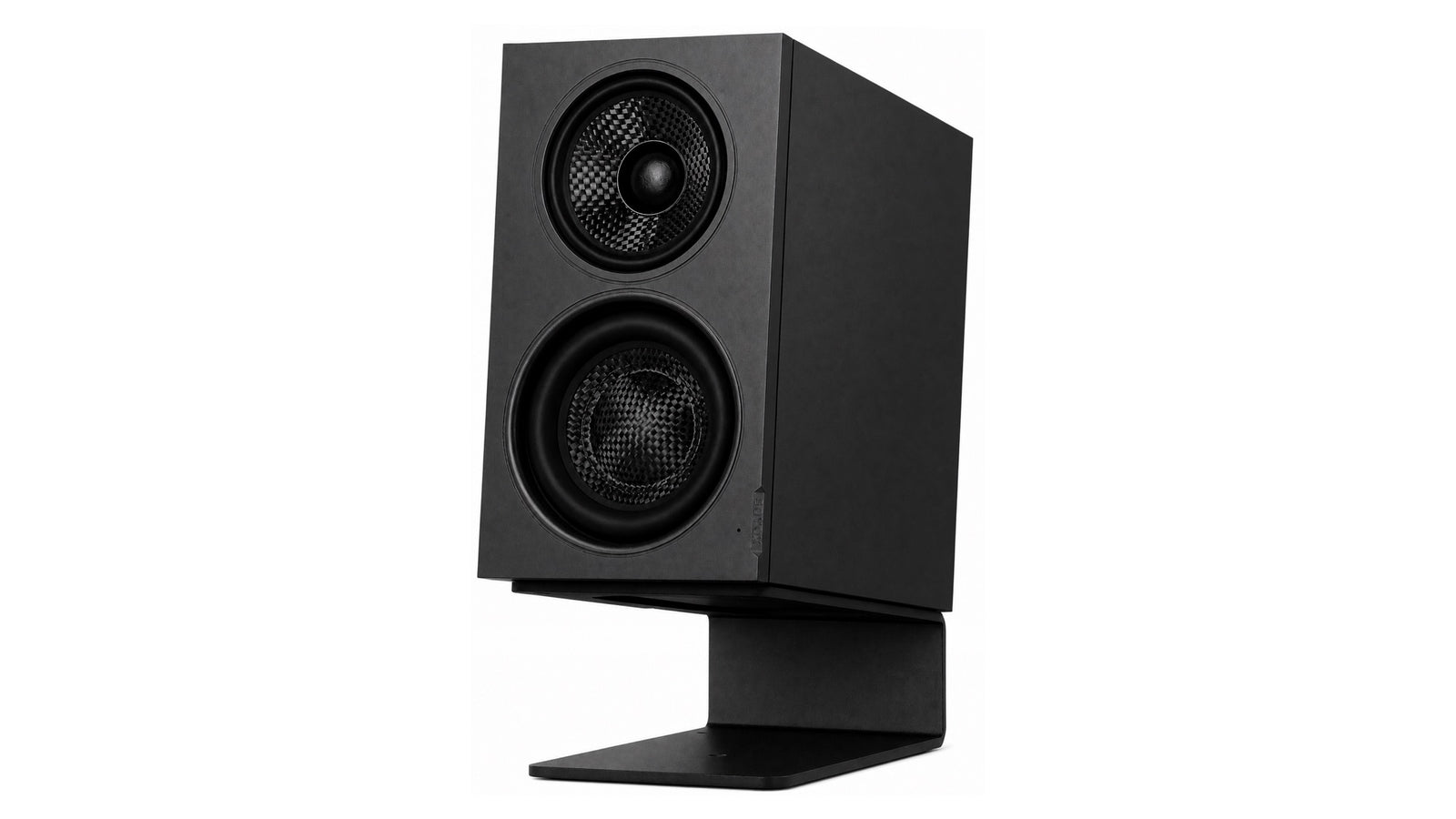
The SOVOX MiniMax3 Monitor uses crossover points at 240 Hz and 3.6 kHz. Its 3.5″ woofer handles the low-frequency band, the 3″ carbon-fibre midrange covers the middle band, and a 1″ silk-dome tweeter handles the top end. The midrange and tweeter are arranged coaxially.

Each band is actively filtered and separately amplified. SOVOX publishes output-power figures of 44.3 W / 17.95 W / 6.32 W for LF / MF / HF, along with the crossover frequencies and full-sphere acoustic measurements.
The value of the topology is not the driver count itself. If the design is working as intended, the evidence should appear in the measured response, directivity and distortion.
What to look for in measurements
For a two-way or three-way monitor, inspect the same four things:
- On-axis and listening-window response: the crossover should not create a broad peak or dip in the main listening region.
- Horizontal and vertical directivity: look for smooth changes with angle rather than abrupt lobes or nulls at the crossover frequency.
- Distortion versus level: a dedicated midrange can reduce excursion burden, but the benefit should be checked at realistic playback levels rather than assumed from topology.
- Compression/output: larger drivers and more ways can provide headroom, but cabinet size, amplifier limits and protection behavior still set the final output.

MiniMax3 has also been independently measured on a Klippel Near-Field Scanner by Erin's Audio Corner. Review unit loaned by SOVOX; the review disclosure states no payment or other compensation.
Two-way vs three-way: which should you choose?
Choose based on the complete design, not the number of ways. A good two-way is often the simplest and most cost-effective solution, particularly when a well-designed waveguide controls the woofer-to-tweeter transition. A three-way becomes attractive when the designer needs more low-frequency displacement, lower midrange excursion, tighter control of bandwidth per driver, or a specific directivity target.
For a compact desk monitor, physical size adds another constraint. A conventional three-way often becomes taller or wider because the midrange needs its own baffle area. Coaxial packaging can recover some of that space by nesting the tweeter and midrange on one axis.
Related: How to choose a compact studio monitor · How to read a spinorama
Frequently asked questions
Is a three-way monitor always more accurate than a two-way?
No. Three-way topology gives the designer more control over bandwidth and excursion, but also adds another driver and crossover. Accuracy depends on the complete acoustic and electronic implementation.
Does a two-way crossover around 2–3 kHz automatically cause audible problems?
No. Many excellent two-way monitors cross in that region. The relevant evidence is whether frequency response and directivity remain smooth through the crossover.
Does a coaxial driver eliminate lobing?
It reduces physical source separation between the coaxial drivers and can make the upper crossover more symmetrical, but it does not eliminate every directivity effect. The measured radiation pattern is the final test.
Does three-way reduce intermodulation distortion?
It can reduce the low-frequency excursion demanded from the driver reproducing the midrange, which can reduce one source of modulation distortion. The amount depends on the drivers, crossover frequencies and playback level, so measurement is preferable to assuming a fixed benefit.
Why are compact three-way monitors less common?
They require another driver, filter/amplifier path and enough physical space to integrate them. Coaxial packaging can reduce the baffle-space penalty, but it adds its own design challenges.
Sources and editorial notes
- Consumer Technology Association — ANSI/CTA-2034-B measurement standard overview
- SOVOX MiniMax3 Monitor — current specifications and measurements
- SOVOX ISP™ coaxial technology
- Erin's Audio Corner — independent MiniMax3 measurements and review
Editorial policy: SOVOX manufactures the three-way monitor used as the worked example. Topology claims are framed as engineering trade-offs rather than universal advantages, and an independent measurement source is provided for the SOVOX product.
MiniMax3 product-specific values were checked against the current SOVOX product page on August 24, 2026.
Share:
Where to Put Small Studio Monitors on a Desk
How to Read a Spinorama