
By SOVOX Engineering · Published August 18, 2026 · Updated August 24, 2026 · SOVOX specifications rechecked August 24, 2026
The short answer
This comparison focuses on three current compact active nearfield monitors that combine a three-way crossover with a coaxial or concentric midrange-tweeter section: the SOVOX MiniMax3 Monitor, Kali Audio IN-5 and Genelec 8331A.
- SOVOX MiniMax3 Monitor: 110 mm wide, 4.1 kg and about $399 each. Its main advantage is the smallest physical footprint in this comparison.
- Kali Audio IN-5: 206 mm wide and about $450 each. It is much larger, offers XLR/TRS/RCA inputs and more boundary-EQ positions.
- Genelec 8331A: 189 mm wide and roughly $2,800–2,900 each. It adds AES/EBU, networked control and GLM measurement-based calibration.
The three speakers share a broad topology but solve different constraints. MiniMax3 prioritizes desk width; IN-5 gives more cabinet volume and output headroom at a similar per-speaker price; 8331A adds a substantially more sophisticated calibration ecosystem at a much higher price.
Scope, methodology and disclosure
The primary group is limited to active nearfield monitors with a dedicated low-frequency section plus a coaxial/concentric midrange-tweeter section and a form factor suitable for short listening distances. Three familiar two-way monitors are included as reference points so the topology decision can be separated from price and physical size.
Manufacturer specifications are preserved with their original qualifiers. Maximum-SPL numbers are not normalized: the brands use different signals, durations, frequency ranges and acoustic conditions. Low-frequency limits are likewise shown with their stated tolerances rather than reduced to one headline number.
Disclosure: SOVOX publishes this article and manufactures the MiniMax3 Monitor. Comparator manufacturers had no editorial involvement. Independent measurements are linked model by model so the acoustic claims can be checked outside the manufacturers' own material.
Three-way coaxial/concentric specification comparison
| SOVOX MiniMax3 Monitor | Kali Audio IN-5 | Genelec 8331A | |
|---|---|---|---|
| Width | 110 mm | 206 mm | 189 mm |
| Height × depth | 195 × 200 mm | 382 × 282 mm | 285 × 212 mm |
| Net weight | 4.1 kg | 8.43 kg | 6.7 kg |
| Configuration | 3-way active + passive radiator | 3-way, tri-amped | 3-way |
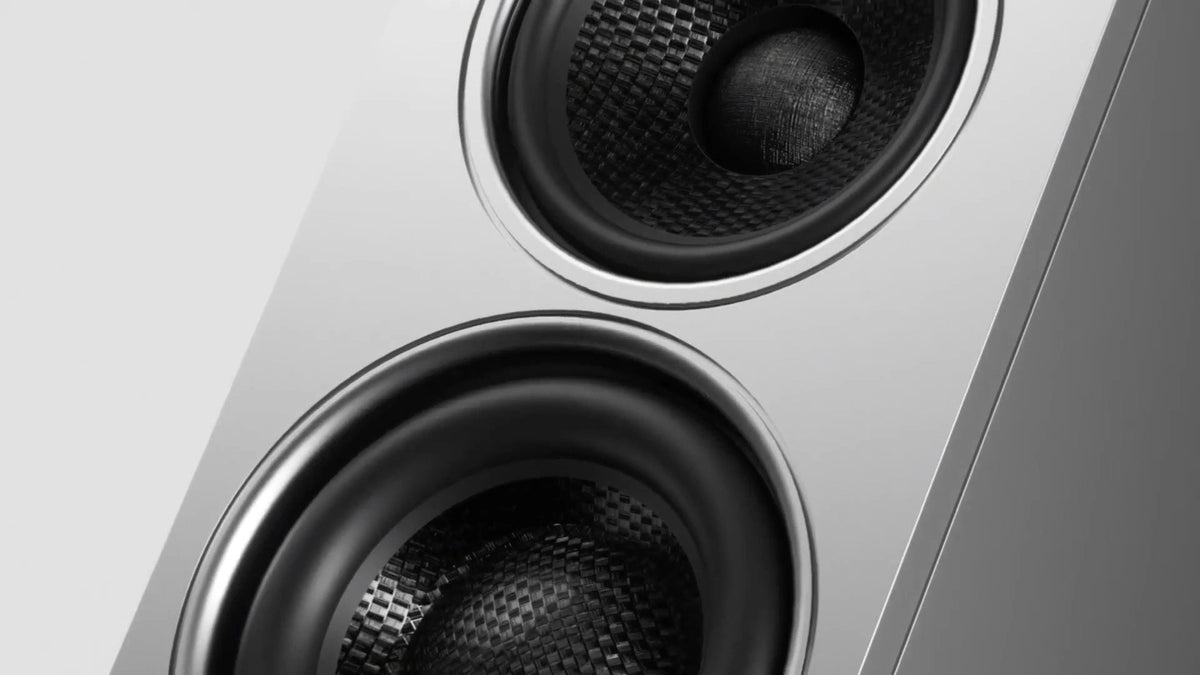
| Coaxial/concentric section | 1″ silk dome + 3″ carbon-fibre midrange (ISP™) | 1″ textile dome + 4″ paper midrange | 19 mm dome + 90 mm midrange |
| Low-frequency section | 3.5″ woofer + 5″-equivalent passive radiator | 5″ paper woofer, front ported | 2 × 65 × 130 mm racetrack woofers |
| Crossover points | 240 Hz / 3.6 kHz | 280 Hz / 2.8 kHz | not published |
| Low-frequency limit | 49 Hz (−3 dB) 46 Hz (−6 dB) |
47 Hz (±3 dB) 39 Hz (−10 dB) |
58 Hz (±1.5 dB) 45 Hz (−6 dB) |
| Published maximum SPL | 97 dB short-term @ 1 m, 100 Hz–6 kHz 95 dB long-term @ 1 m, IEC 60268-5 condition |
115 dB peak @ 1 m | ≥104 dB short-term sine, half-space, 100 Hz–3 kHz |
| Analog inputs | XLR (+4 dBu), RCA (−10 dBV) | XLR, TRS, RCA | XLR balanced |
| Digital / network | — | — | AES/EBU, GLM control |
| Placement / calibration | 4 modes: Free / Desk / Wall / Desk & Wall | 7 boundary-EQ positions | GLM measurement-based calibration |
| Cabinet | Aluminium | MDF, vinyl wrapped | Die-cast aluminium |
| Indicative US price, each | ~$399 | ~$450 | ~$2,800–2,900 |
Primary specification sources: SOVOX MiniMax3 Monitor · Kali Audio IN-Series · Genelec 8331A. Comparator figures and indicative prices were checked August 18, 2026; SOVOX values were rechecked August 24, 2026.
Two-way nearfield reference group
These are not topology-matched substitutes; they are familiar compact alternatives that show what buyers can get when three-way/coaxial architecture is not a requirement.
| Neumann KH 80 DSP | ADAM Audio T5V | JBL 305P MkII | |
|---|---|---|---|
| Width | 154 mm | 179 mm | 185 mm |
| Height × depth | 233 × 194 mm | 298 × 297 mm | 298 × 231 mm |
| Net weight | 3.5 kg | 5.7 kg | 4.73 kg |
| Configuration | 2-way (4″ + 1″) | 2-way (5″ + ribbon) | 2-way (5″ + 1″) |
| Low-frequency limit | 57 Hz (±3 dB) | 45 Hz (−6 dB) | 49 Hz (±3 dB) 43 Hz (−10 dB) |
| Published maximum SPL | 108.8 dB calculated, half-space, 3% THD | ≥106 dB per pair @ 1 m | 94 dB continuous / 108 dB peak |
| Analog inputs | XLR, 6.3 mm jack | XLR, RCA | XLR, TRS |
| Placement compensation | 4-position low-mid control | HF and LF shelves | Boundary EQ + HF trim |
| Indicative US price, each | ~$600 | ~$240 | ~$170 |
Primary sources: Neumann KH 80 DSP · ADAM Audio T5V · JBL 305P MkII
Do not rank the SPL row as if it were one test. Peak versus continuous, one speaker versus a pair, sine versus broadband noise, calculated versus measured and different frequency ranges can move the number substantially. The same caution applies to bass extension: −10 dB and ±1.5 dB are not equivalent criteria.
What matters most in practice
Desk footprint
Width is the clearest physical difference. MiniMax3 is 96 mm narrower than the IN-5 and 79 mm narrower than the 8331A. A stereo pair uses 220 mm of cabinet width before spacing and toe-in, versus 412 mm for two IN-5s.
At 4.1 kg, MiniMax3 is also less than half the IN-5's 8.43 kg. Weight does not determine sound quality, but it changes which desktop stands, clamps and arms are practical.
Low-frequency extension
Always keep the tolerance attached to the frequency. MiniMax3 is specified at 49 Hz (−3 dB) and 46 Hz (−6 dB). Genelec publishes 58 Hz (±1.5 dB) and 45 Hz (−6 dB) for the 8331A. Those pairs answer different questions; quoting only “45 Hz” or “46 Hz” removes essential context.
Placement and room integration
Kali provides multiple boundary-EQ switch positions, MiniMax3 provides four placement presets, and Genelec's GLM system uses a measurement microphone and software to calculate calibration. These are three different levels of intervention. Presets can correct broad boundary-related tonal balance, but they do not replace measurement in a difficult room and cannot reliably fill a deep reflection cancellation.
Further reading: Where to put small studio monitors on a desk
Two-way versus three-way
A dedicated midrange lets a three-way divide bandwidth and low-frequency excursion among more drivers, but it also adds another crossover. A well-designed two-way can outperform a poorly integrated three-way. Coaxial/concentric packaging reduces source separation for the upper crossover, but the measured directivity remains the final test.
Further reading: Two-way vs three-way studio monitors
Independent measurements
Each model in this comparison has public third-party acoustic data, which is more useful than treating topology or marketing language as proof of performance:
- SOVOX MiniMax3 Monitor — Erin's Audio Corner
- Kali Audio IN-5 — Erin's Audio Corner
- Genelec 8331A — Erin's Audio Corner
- Neumann KH 80 DSP — Audio Science Review
- ADAM Audio T5V — Audio Science Review
- JBL 305P MkII — Erin's Audio Corner
The MiniMax3 review unit was loaned by SOVOX. Erin's disclosure states that the review was unpaid and uncompensated.
Which one should you choose?
If desk width is the hard constraint: MiniMax3 is the narrowest model here at 110 mm.
If you want a larger three-way near the same per-speaker price: IN-5 gives up considerably more desk space but adds cabinet volume, input flexibility and more boundary-EQ switch positions.
If measurement-based room integration is the priority: 8331A's GLM ecosystem is the most comprehensive of the three and is priced in a different tier.
If maximum output is the priority: compare independently measured compression/distortion at your intended listening distance rather than ranking the incompatible manufacturer SPL figures.
If three-way is optional: KH 80 DSP, T5V and 305P MkII illustrate that capable two-way monitors exist at both lower and higher price points. Topology should follow the use case.
Frequently asked questions
Which is the narrowest three-way coaxial/concentric monitor in this comparison?
SOVOX MiniMax3 Monitor at 110 mm, versus 189 mm for Genelec 8331A and 206 mm for Kali IN-5.
Is MiniMax3 louder than the other models?
The manufacturer SPL specifications are not directly comparable because the test methods differ. Use independent output/compression data for a fairer comparison.
Is three-way automatically better than two-way?
No. Three-way design can reduce bandwidth and excursion demands per driver, but adds another crossover and integration challenge.
Does MiniMax3 need an audio interface?
No. It accepts balanced XLR at +4 dBu and unbalanced RCA at −10 dBV. USB-C is for firmware updates, not USB audio.
How much desk width does a MiniMax3 stereo pair occupy?
The two cabinets account for 220 mm of total width before spacing and toe-in.
Sources and editorial notes
Manufacturer specifications: SOVOX · Kali Audio · Genelec · Neumann · ADAM Audio · JBL Professional.
Editorial policy: SOVOX manufactures one product in this comparison. Manufacturer facts are separated from interpretation, test qualifiers are retained, limitations are stated, and independent measurement sources are linked. Comparator manufacturers did not review or approve this article.
Specifications and prices change. Comparator data and indicative pricing were checked August 18, 2026; current MiniMax3 values were rechecked August 24, 2026.
Teilen:
How to Choose a Compact Studio Monitor
Do You Need an Audio Interface for Studio Monitors?